 TEXTILES.ORG




The Global Electronics Association continues to be a driving force in global electronics standardization. In 2025, the organization, originally named the Institute for Printed Circuits, then IPC, was rebranded to reflect the increasingly diverse ecosystem it serves, including the fast-growing world of e-textiles.
The association brings together technology innovators, engineers, manufacturers, OEMs, product brands and academia
to support more than 300 standards for the electronics industry. The organization is based on the work of thousands of participants in open, consensus-driven processes to help technologies move from concept to design to reliable, market-ready products.
E-textiles are at exactly that inflection point. From biometric monitoring garments to wearables for soldiers, connected worker systems and responsive consumer products, the potential for integrating electronics directly into textile systems is enormous. Translating that into scalable and commercially viable products has remained a challenge — not because the technology isn’t ready but because the frameworks, terminologies, reliability assurances and shared reference points needed to support cross-disciplinary development teams have been lacking or missing.
Reliability is at the heart of that challenge. Unlike traditional electronics, e-textiles must maintain functionality and preserve comfort, wearability and manufacturability while enduring repeated flexing, stretching, abrasion, moisture exposure, temperature variation and washing cycles.
The Global Electronics Association’s working groups have developed standards, test methods and guidance serving as the global framework for the e-textiles industry. This spans yarn characterization; reliable integration of electronics into textiles; design, qualification and performance testing; and even system-level reliability.
Testing for the real world
The standard IPC-8981, Quality and Reliability of E-Textiles Wearables, released in April 2025, established the first comprehensive testing and reliability framework for e-textile wearable products. It defines standardized durability and exposure tests that mirror real-world conditions across the product life cycle, including 13 characteristics or exposures. Products can be tested using 14 new methods developed for e-textiles testing. To measure performance, the product is also tested for electrical and sheet resistance before and after each method to assess any change in electrical resistance.
The standard aligns exposure expectations with the IPC Product Classification System, scaling from Class 1 (commercial) through Class 3 (mission-critical), and includes provisions for short-term and single-use applications, such as disposable health-monitoring patches.
IPC-8981 also defines the functional and critical areas of a product for testing. This is a practical approach to testing, reducing product waste and enabling manufacturers to ensure testing focuses on the product areas that matter most.
Consider a single-use neonatal monitoring wrap used in a hospital to track vital signs during patient transport. Because performance on demand is critical and failure could affect clinical decision-making, the consumer may specify the product as Class 3. However, because it is intended for short-duration use and disposal after use on one patient, the customer and supplier can agree to identify it as a Class 3 single-use/short-term-use product.
In this case, rather than the product being tested as if it must survive months or years of laundering and wear, testing can focus on limits for single-use and short-term performance. Testing for irrelevant conditions (in this case, laundering) can be avoided.
Qualification testing can further define only the essential parts of the product. Functional areas could include the conductive pathways, sensor zones, connector attachment points and any textile-integrated circuits. Critical areas would be a subset of those functional areas where failure would most directly affect product performance or patient safety, such as the sensor interface, interconnect locations between the textile circuit and electronics module, or conductive traces that will experience bending during placement or removal.
The result is a more meaningful qualification plan that focuses on rigor — specifically where reliability matters — and is not burdened by testing for exposures the product will never experience.
Reliability from the conductive yarn up
Product reliability starts at the most fundamental level of the supply chain. It was for this reason that IPC-8911, Requirements for Conductive Yarns for E-Textiles Applications, was developed. Released in May 2025, it represents the first global standard dedicated to characterizing and testing conductive yarns.
IPC-8911 provides essential benefits to the supply chain, introducing a clear designation system that streamlines communication between yarn suppliers and product developers, simplifying procurement decisions and reducing development risk.
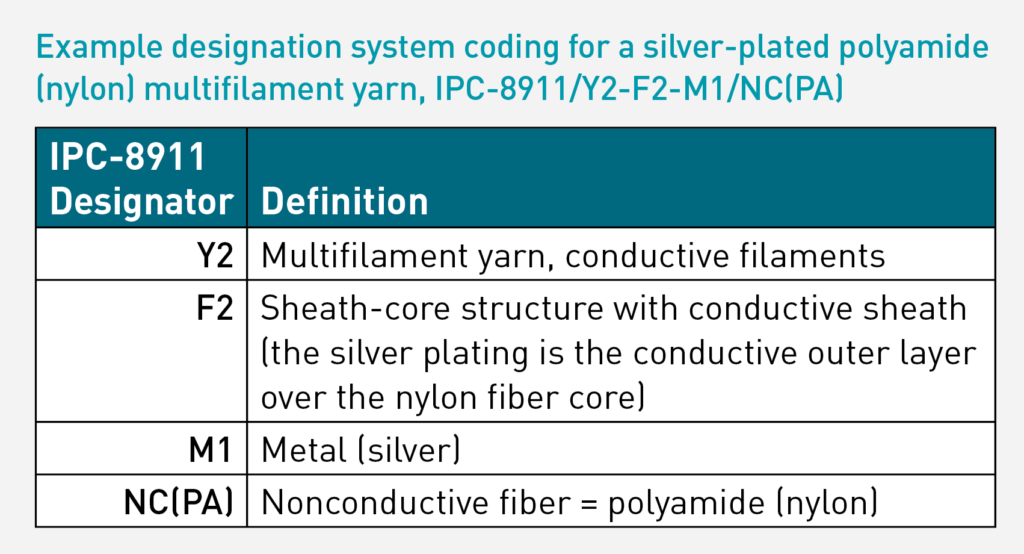
For example, a conductive yarn used in biometric monitoring garments, smart personal protective equipment or straps on an electrocardiogram, is a silver-plated polyamide (nylon) multifilament yarn. Its IPC-8911 designation would be specified on
the product order as IPC-8911/Y2-F2-M1/NC(PA).
This designation system gives a yarn supplier an unambiguous description of exactly what material is required, removing the need for clarification on construction type, fiber structure and base material. (See chart below.)
From a characterization perspective, the standard calls out eight new IPC test methods developed for conductive yarns. This provides buyers of conductive yarns an “apples to apples” means to assess similar conductive yarns.
Building on that materials foundation, IPC-8921, Requirements for Woven and Knitted Electronic Textiles (E-Textiles) Integrated with Conductive Fibers, Conductive Yarns and/or Wires, establishes the classification and qualification requirements for woven and knitted e-textiles. Its upcoming Revision A will align the standard with the IPC-8911 yarn designation system and expand the scope of the standard to include braided products. Additionally, the standard will bring qualification testing for these products into the IPC Classification Testing Categories used in IPC-8981, incorporating the same new IPC test methods developed for IPC-8981. This provides a consistent approach in qualification testing from the manufacturing of the e-textile to the end product wearable covered in IPC-8981. The result is a unified performance framework that applies across three e-textile types, based on separate manufacturing processes but which are all expected to apply to similar performance metrics. The working group responsible for IPC-8921A plans to release this standard by the end of the year.
A parallel path: printed electronics
Conductive yarn-based e-textiles are one major pathway for integrating electronic functionality into soft systems, but they are not the only one. Printed electronics technologies have seen a lot of use in textile-based applications. Three specific standards address these e-textiles systems:
1. IPC-8952, Design Standard for Printed Electronics on Coated or Treated Textiles and E-Textiles: Released in 2022, this was the first design standard for this space, adapting design practices for printed electronics on flexible substrates to textile substrates. It defines documentation, materials selection, trace layout, dielectric structure and component-interface requirements to ensure electrical stability and product durability.
2. IPC-8971, Requirements for Electrical Testing of Printed Electronics E-Textiles: This complements IPC-8952 by defining how to electrically evaluate printed electronic features on textile substrates. It focuses on confirming that printed conductors and conductive patterns meet their intended electrical requirements (continuity, isolation and resistance) so that products can be consistently validated.
3. IPC-8922, Qualification and Performance Specification for Printed Electronics on Coated or Treated Textiles and E-Textiles:
This is the newest addition to this printed electronics ecosystem and e-textiles standards, coming soon to our library. IPC-8922 builds on IPC-8952 by establishing qualification, performance and acceptance requirements for printed electronic e-textiles.
Together, IPC-8952, IPC-8971 and IPC-8922 provide a comprehensive path from printed e-textile design to electrical test, qualification and production acceptance.
Connecting the dots
Developing successful e-textiles requires expertise from industries that have historically worked in very different ways. Textile engineering, electronics manufacturing, materials science, garment design, software, sustainability, cybersecurity, human factors and end-user behavior can all intersect within a single product. Decisions made in one area often affect performance in another.
To help address this system-level challenge, the Global Electronics Association released Fundamentals and Best Practices for E-Textile System Development, the first publication in the association’s Technology Solutions next-generation guidelines.
Developed by an international working group of industry and academic experts, these guidelines cover reliability characteristics; materials and components; integration methods such as weaving, knitting, braiding, lamination, embroidery and conformal coating; interconnection approaches; product examples; sustainability; cybersecurity; and end-user guidance.
A framework built to evolve
The IPC standards and new guidelines covered here together form a comprehensive, interconnected framework for the e-textiles industry. None of these documents are static. They are built and maintained through the collective expertise of a global supply chain and will continue to evolve as e-textiles move from promising innovation toward commercially mature technology.
As new materials, integration methods, product categories and reliability challenges emerge, the Global Electronics Association will continue working with industry to revise existing standards and develop new resources where gaps remain. Revisions will depend on continued and expanded contributions from industry. Whether you want to lead new standards work or contribute to the next versions, there is a place for your perspectives.
Chris Jorgensen is senior director, Next-Generation Standards, for the Global Electronics Association. To learn more about these projects as well as others that are in early stages of development, contact ChrisJorgensen@electronics.org or the association’s e-textiles staff liaison Francisco Fourcade at FranciscoFourcade@electronics.org.
The standards and guidelines are available through the association’s bookstore, and IPC test methods are available for free download at www.electronics.org/test-methods.