 TEXTILES.ORG





For nearly 50 years, Paul’s Custom Canvas has made a name for itself in Denver, Colo., through steady work and reliable craftsmanship.
There is no flashy advertising for the shop’s boat tops and covers, upholstery, and marine flooring. The team doesn’t travel to customers—boats must be brought to the shop. They don’t take shortcuts, and they don’t negotiate on price.
Consistent, top-quality work that lasts is the reason customers return and refer. And it’s what co-owner Mike Charpentier is most proud of preserving over the last nine years that he and his brother have managed the business started by their father, Paul.
Stepping into leadership
Charpentier spent his summers during high school working at the shop and became a full-time employee in 1999. Just one year later, with his commitment to one day take over the business, his father bought the building they were renting and remain in to this day. Charpentier’s brother, Scott, joined a couple of years later, but it was more than a decade before they began putting Paul’s retirement plan into place.
“We made sure we had the trade down really well before learning any of the day-to-day operations,” Charpentier recalls. “He then slowly started giving us a little more responsibility until he could take two weeks off and then the winter off and then every day off. But if we’re ever completely buried, he comes out of retirement to help so we don’t miss any customer deadlines.”

Building on proven practices
As partners, Charpentier and his brother have designed a system that works for them. “We work well together when we don’t work together,” he jokes. Charpentier handles the canvas side of the business while his brother manages the upholstery. “We absolutely make decisions together and help each other on different projects, but we know when and how to stay out of each other’s way to do what’s best for the business,” he says.
Their approach fits within the framework their father shaped from the beginning—one built on practical systems and habits that are functional yet flexible. “He set up such a great business model that I’m just trying not to screw up what he built,” Charpentier says. “That doesn’t mean we don’t face challenges or change to be more efficient, but we haven’t needed to do anything drastic.”
This made the process of transitioning from hand patterning to digital technology relatively easy, especially for a smaller shop with 12 employees total, including Charpentier. “We were fortunate our father saw that as a necessity for the future success of the business early on. He wasn’t interested in doing it himself, but he handled a good portion of the workload while I focused on learning it. And today we continue to prioritize adapting and incorporating new hardware and technology.”
Alongside the craft, maintaining strong customer relationships has been central to the shop’s success. Charpentier and his brother continue to solidify the connections they’ve established over several years with local boat dealers, who drive the majority of both repeat and new business. “The biggest advertising we have is word of mouth,” Charpentier says, adding that he is working to build a stronger social media presence as another advertising channel.
Optimizing the little things
Beyond the shop, Charpentier puts his expertise to work on the Marine Fabricators Association (MFA) advisory board, of which he has been a member since 2021 and for which he became the vice chair in 2025.
“I learned so much from MFA members over the years that it was important for me to give back and help the organization continue to be a critical education tool,” he says. “A rising tide raises all boats. When we share methods and strategies for success, we’re all better for it, from fabricators to customers to suppliers.”
Charpentier can’t identify a singular significant technique he has incorporated from another member, but that’s his point. “If you put 100 fabricators in a room, you’re going to find 100 different ways to do something. So, if you can learn one little thing that helps you work better, that’s a win—and vice versa,” he says. “You never know what somebody might be struggling with that you do naturally every day.”
He values the informal learning among members just as much as the structured MFA seminars he helps organize, striving to provide relevant takeaways for every type of member.
“It’s been a fun challenge to create educational programming that includes the right balance of digital and traditional techniques that can keep everybody’s interest, whether they’re a one-man shop or they have multiple contracts with mega yacht companies,” he says.
What has stuck with Charpentier most is the confidence he’s gained in his instincts and in his shop’s operations. “The MFA has helped me more clearly see myself as a professional whose opinion customers value. I’ve learned to be firm in my answers, when to say ‘no’ and when to not compromise on something I don’t feel right doing,” he explains. “This is why we don’t negotiate our prices. For a long time, I felt bad saying that, but after talking to enough people in the MFA, I got comfortable with saying it’s what I have to do to get by. Every decision I make affects my employees and their families, and making sure they’re taken care of is a responsibility I do not take lightly.”
This decision has proven to be helpful as customers grow more particular and demanding in their requests. “We have learned to set expectations immediately when explaining what we can and can’t do,” Charpentier says. “One example is customers asking for waterproof materials or just not understanding material properties. In Denver, we face a unique challenge with our altitude, because the sun destroys everything much faster than it does in other parts of the country. Certain materials simply won’t work here.”
Even the toughest discussions with customers are part of what he enjoys most: collaborating to bring a vision to life and witnessing their excitement when it’s finished. “It’s the best part and makes all of the challenges that come with being a business owner worth it,” he says.
With a love for the trade as strong as it was when he began his career, Charpentier is looking forward to maintaining the rhythm and rigor that have benefited the business and its customers since 1979. “Growth is always a goal,” he says, “but I’m comfortable with where we are and focused on continuing to do what works best for us.”
Holly Eamon is a business writer and editor based in Minneapolis, Minn.
Photography by Kristie Allbritten Spoken For Photography
PROJECT SNAPSHOT
When stripes align
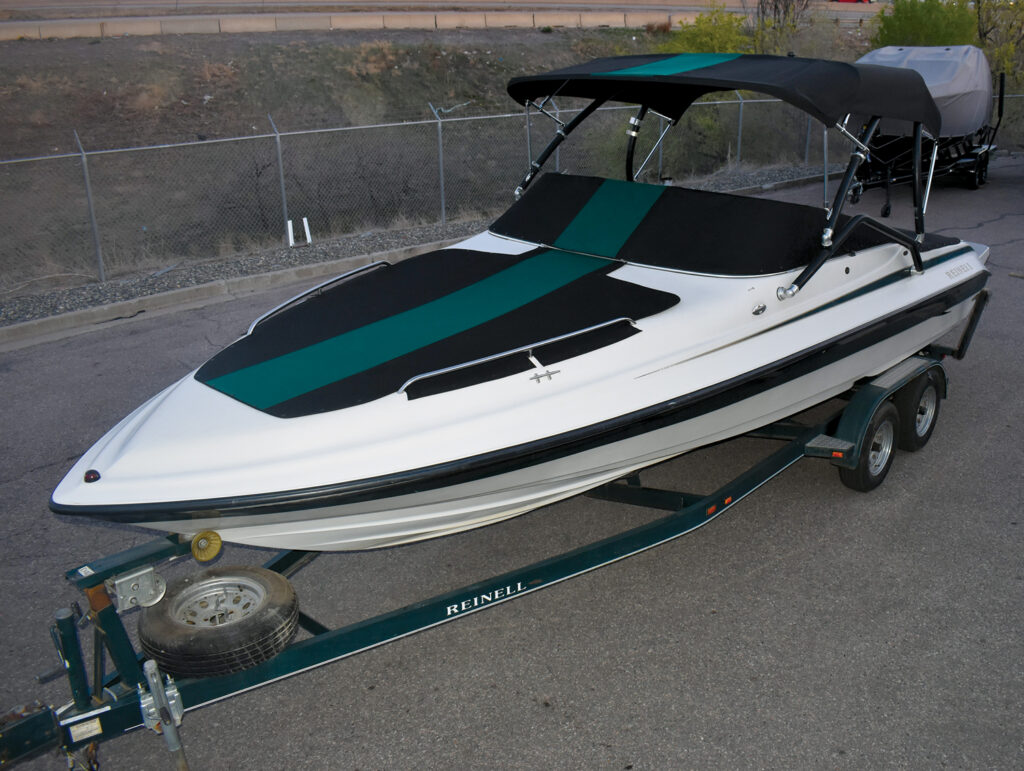
Last April, a friend of Mike Charpentier requested a custom, mounted 6-foot bimini and a snap-on cockpit cover and bow cover for his 240 Reinell tower. With no specific design demands to meet, Charpentier decided to surprise his friend with a striking stripe pattern. “It’s not particularly unique to do stripes, but it is not something we normally do,” Charpentier says. “And his reaction was more than worth the extra time it took.”
Using 20 yards of Sunbrella® fabric, Charpentier and team spent 20 hours getting the project just right. “The biggest challenge was lining the stripes up between the three covers,” he says. “Each cover is patterned separately, so we had to make multiple marks on the boat and transfer them between the covers. It is always tricky to get the bimini frame to be as long as the customer wants it to be—while still ensuring it can be stored properly on the wakeboard tower—so the customer can use the tower without the bimini frame being in the way.”
Image: Paul’s Custom Canvas
SIDEBAR: Q&A
How do you recharge outside of work?
I like to stay active and dabble in a little bit of everything: fishing, golfing and long-distance running. I don’t have time to train for a full marathon right now, but I do enjoy half-marathons.
It’s important for everyone who can to make time to relax and do the things they enjoy. Our typical business hours are Tuesday to Saturday, and even though I work a lot of Mondays during our busy season, I always take Sundays off.