This page was printed from https://specialtyfabricsreview.com

Textiles’ wide range exhibited at Venice Biennale 2026

Swatches | October 1, 2025 | By:

3D knitted flax sculpture

A gray knitted textile sculpture. It is on brown carpet and the space between the woven parts of the sculpture and the light on it make shadows on the carpet.
The biodegradable CNC-knitted textile sculpture, Necto, made of linen, flax and PVA, was transported to the site in suitcases and selectively stiffened upon installation. Image: La Biennale di Venezia/Marco Zorzanello

Another collaboration between design studio SO – IL and structural designer Mariana Popescu, Ph.D., on a machine-knitted sculpture (see also August 2024 Specialty Fabrics Review) brought about Necto. It is constructed of 12 knit pieces and spans 100 square meters (1,076 square feet). Design and research firm TheGreenEyl also shares credit on this installation.

“Hoisted into place, shaped by tension and selectively stiffened [during installation], Necto enacts a form-finding exercise that speculates on the future of temporary structures—flexible, efficient and reconfigurable,” describes the Venice Biennale site.
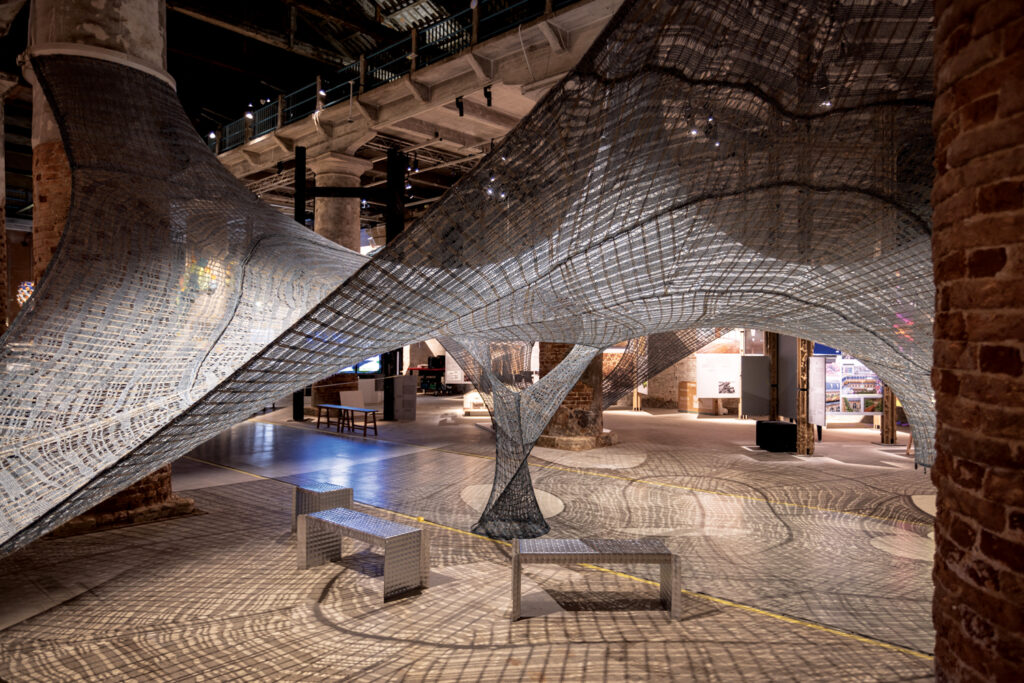
A large gray knited textile sculpture whose design and the lighting of the room result in various lines of shadows on the brown flooring. There are two silver benches underneath the sculpture.
Image: La Biennale di Venezia/Marco Zorzanello

It’s made of flax, linen and PVA and has a coating that makes the fibers traceable. Following the exhibition, the applied stiffener will be dissolved, and the sculpture will be packed up for transport in suitcases.

This year’s Venice Biennale began May 10 and continues to Nov. 23. While this is only the 19th International Architecture Exhibition, the annual cultural event has been going on since 1895.


A person wearing a white and red long-sleeved jacket with a space galaxy background. Only the person's neck, torso and arms are visible.
The Massachusetts Institute of Technology’s BioSuit™ is a skintight spacesuit that offers improved mobility and reduced mass compared to modern gas-pressurized spacesuits. It was on display at the Venice Biennale in an area featuring robotics and artificial intelligence that spotlighted how humans and technology have become interdependent. Image: MIT/Jose-Luis Olivares

a fabric architecture bookstore with a blue floor and tan bookshelves on either side filled with multicolored books. On the left, a person stands, browsing the books.. The walls are transparent and there are trees visible.
La Libreria, by Diller Scofidio + Renfro Studio, is the bookshop of Venice Biennale. A lightweight unanchored temporary structure, it is stabilized by the weight of its books and shelves. An elongated tensegrity beam spans the axis of the space, supporting the tent’s fiber-reinforced transparent STFE skin. It spans 24 meters (79 feet). Image: La Biennale di Venezia/Andrea Avezzù
Multiple people walking in front of a fabric architecture bookstore that is silver on each side and tan on the front. A person browsing books is visible from the open doorway of the bookstore. There are trees surrounding the paved area where the bookstore is.
Image: La Biennale di Venezia/Andrea Avezzù

Handwoven knotted rug of Quito

A multicolored rug in the shape of Ecuador hung on a bright orange wall. There is a blue line that runs along the far right side, from above the rug on the wall, through it, to the bottom of the wall. On the side of the line, it reads "0'00'00 Quito, Ecuador."
Quito Fragmented by María Isabel Paz, at the 2025 Venice Biennale. Image: La Biennale di Venezia/Sergio Pierone

Quito Fragmented honors the centuries-old craft of creating knotted rugs as practiced in the small village of Guano, Ecuador. Traditionally, these are rectangular rugs created by a single artisan, handmade with 42,000 knots per 1 square meter (10.8 square feet). This project employed digital design to distort a map of Quito to create an asymmetrical shape with curves and irregular forms. The artwork was created with local sheep’s wool processed by the area’s remaining spinning shop. It was a collaboration among multiple artists. Only 11 people still practice this craft.
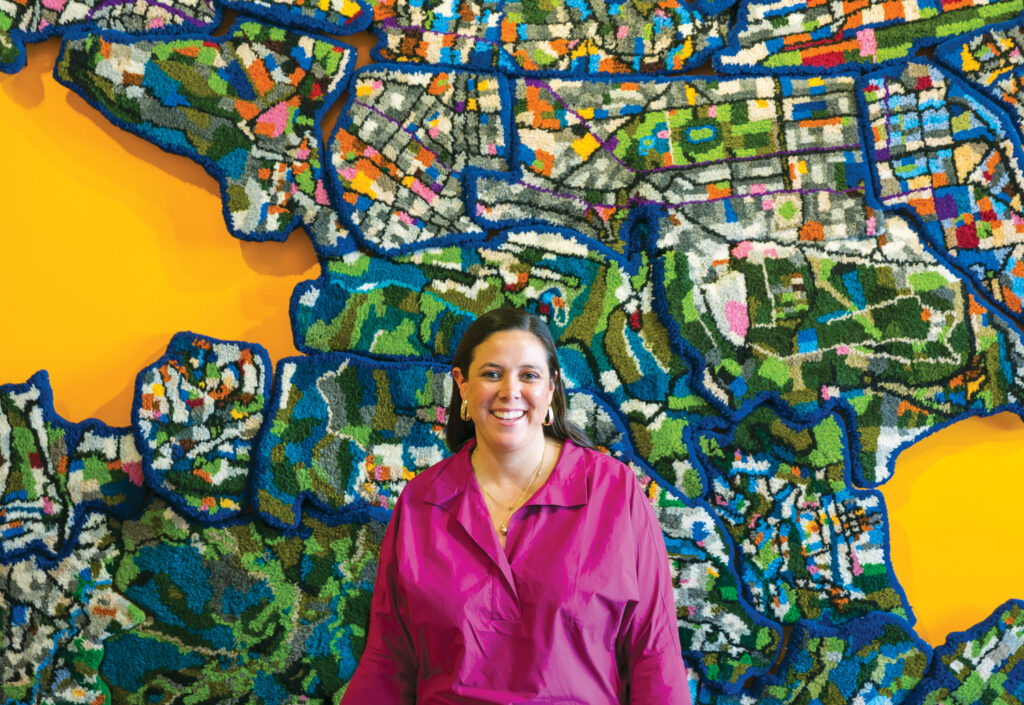
María Isabel Paz in front of her rug artwork Quito Fragmented, which is an abstract inspired by a map of the city
Image: La Biennale di Venezia/Sergio Pierone

The art piece was designed by María Isabel Paz, an Ecuadorian designer and professor based in Quito. She leads Materia-Arquitectura & Design, a studio focused on architecture, interiors, art and research.
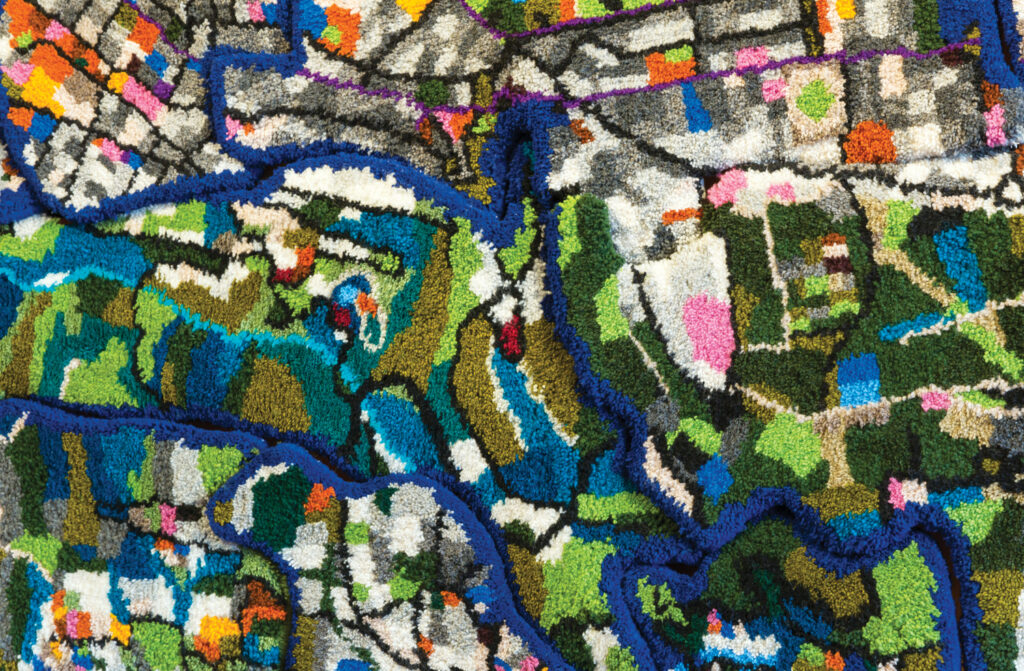
A close-up of the rug artwork Quito Fragmented, which is an abstract work inspired by a map of the city
Image: La Biennale di Venezia/Sergio Pierone

Share this Story