 TEXTILES.ORG




The creation of sustainable textiles has been top of mind for the textile industry since the 1990s. Along with recycled polyester and circular textile-to-textile manufacturing, fibers created from bio-based inputs are finding increasing applications in innovative textile fibers. With a focus on performance, biosynthetic fibers are moving toward commercialization.
Sustainability is key; these bio-based fibers are either biodegradable or recyclable, are less toxic to the environment, and offer a reduced CO2 footprint compared with polyester and nylon. But just as important, the new biosynthetics can be fine-tuned with performance characteristics such as softness, elasticity, strength, and even water repellency or burn resistance.
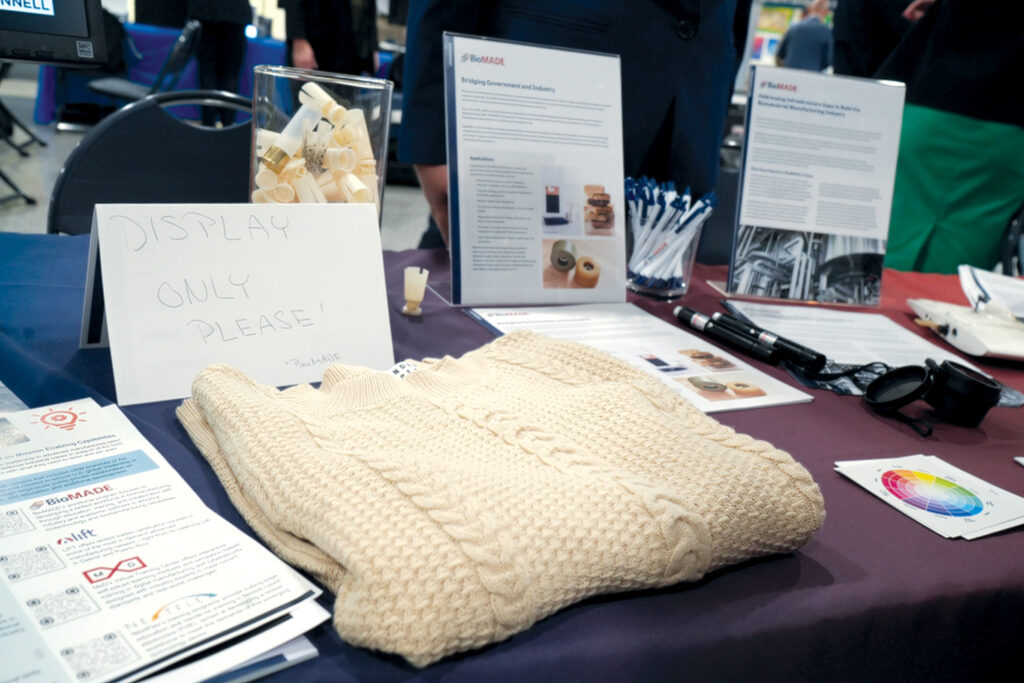
“Biosynthetic fibers introduce novel properties that will continue to revolutionize textiles,” says Penny Norquist, program director of technology at BioMADE™, which was launched in 2021 by the U.S. Department of Defense (DOD). “The benefits extend far beyond sustainability.”
Climate-positive and smart
“Our bio-manufactured fibers provide properties that synthetic fibers don’t have, so sustainability is a plus but not the main point,” says Melik Demirel, an engineering professor at Penn State. Demirel is co-founder of startup Tandem Repeat Technologies.
Demirel and his team created a strong, flexible fiber called Squitex, inspired by the proteins found in squid tentacles. Procell™ is Tandem Repeat’s current commercial product, which combines proteins from spent yeast biomass fermentation with solution spinning for broader application. Procell’s greenhouse gas emissions and water usage are also lower than those of many natural fiber products.
Tandem Repeat has a line of knitted sweaters called Sonachic and is working with BioMADE and the DOD to develop clothing that meets the needs of the U.S. military without relying on per- and polyfluoroalkyl substances (PFAS), or “forever chemicals.”
“We have developed extreme-weather clothing, which provides both sustainability and a ‘no-melt/no-drip’ property, which is critical for DOD applications,” says Demirel.
The need for funding is constant, and the company has raised $9 million from investors, contracts and awards so far, including $1.5 million from the Defense Industrial Manufacturing Consortium. According to Demirel, Tandem Repeat is seeking additional funding from the government and private investors.
Sustainable plastic
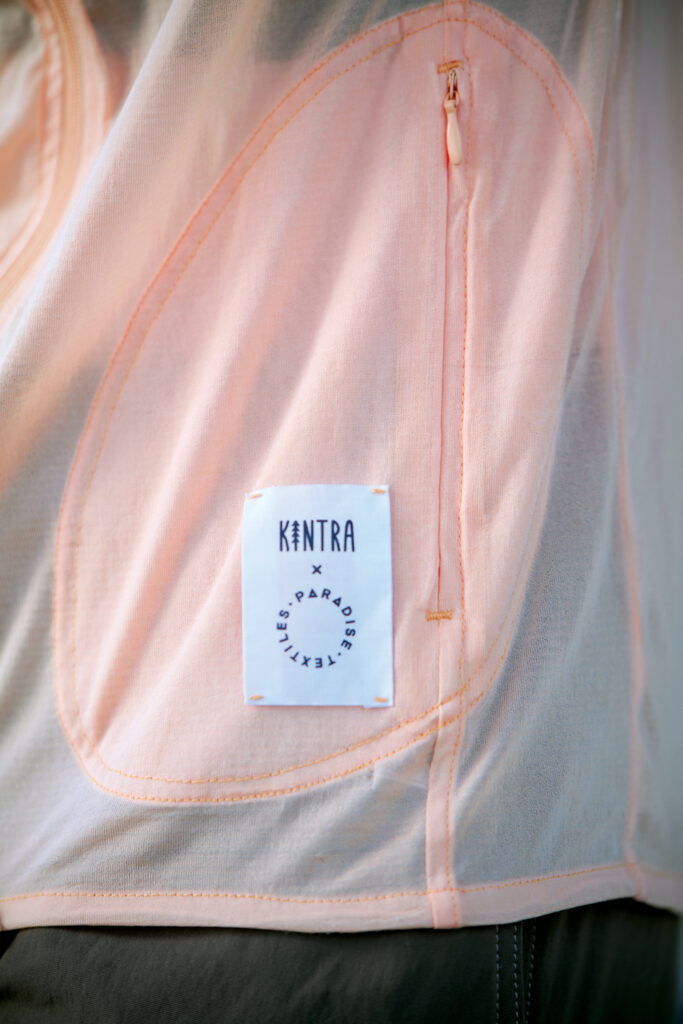
Brooklyn, N.Y.-based Kintra Fibers is currently developing polybutylene succinate (PBS), a bio-based, tunable and compostable plastic. Using monomers created from the fermentation of sugars derived from wheat and corn, Kintra’s proprietary PBS fibers are a non-petrochemical alternative to polyester and nylon.
In 2023, Kintra raised $8 million in Series A funding and achieved a commercial pilot with its partners. “We’re engaged with a number of global apparel industry leaders, including Inditex, Reformation, H&M, Bestseller and Paradise Textiles,” says Alissa Baier-Lentz, co-founder and chief operating officer.
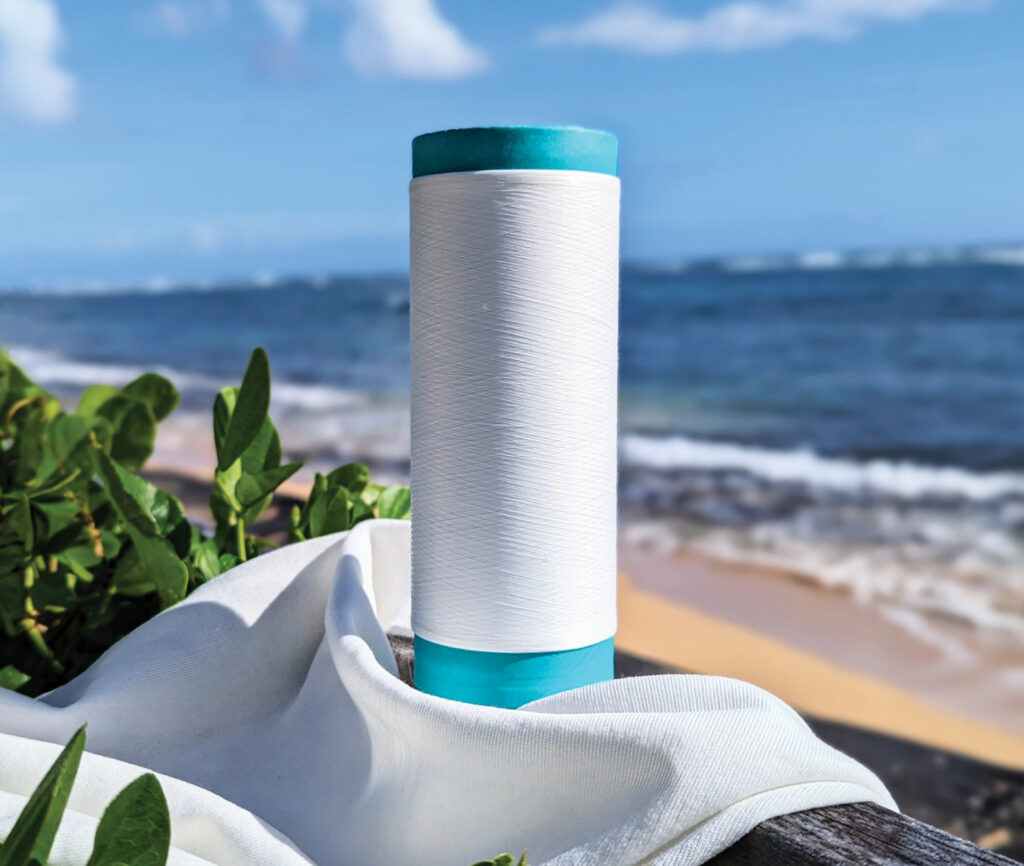
A flagship 75/72 denier per filament yarn spec has been spun, textured, knitted and woven with multiple partners and tested in both knit and woven constructions, according to Baier-Lentz. Independent lab results confirm the yarn’s strong tenacity, durability, stretch and recovery. The fiber is compatible with standard dyeing and printing methods.
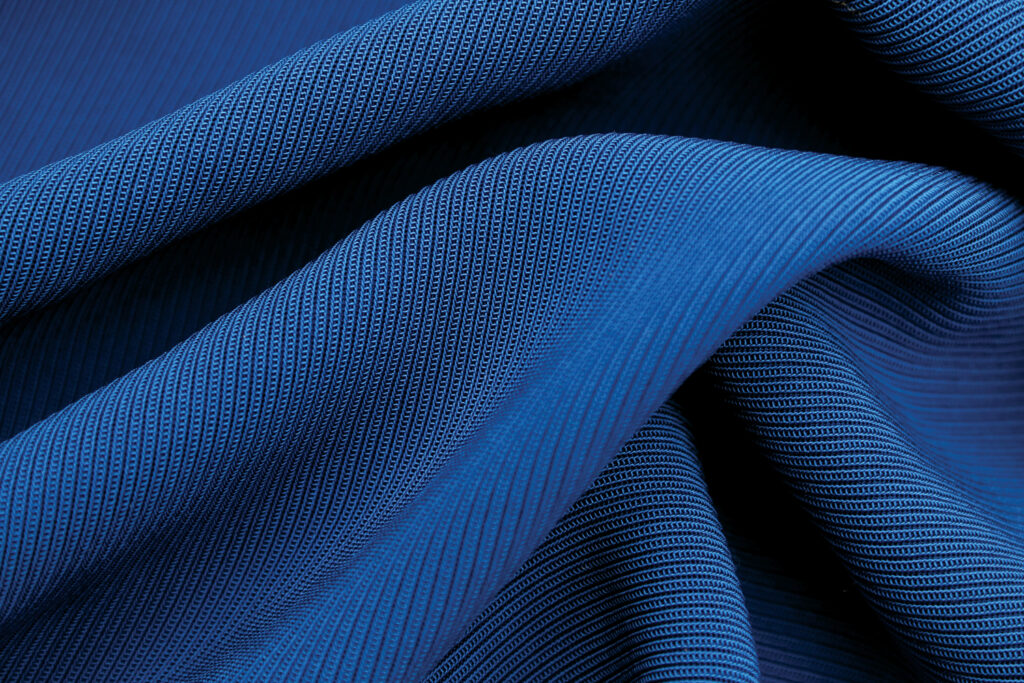
“Kintra spins more efficiently, produces finer fibers and delivers a softer hand feel than generic PBS—making it a true step forward both technically and commercially,” says Baier-Lentz. “We’ve locked in supply chain partners for resin, yarn spinning and mills at commercial scale. The challenge now isn’t proving the science; it’s scaling production fast enough to meet demand.
“Our partners want more than a green story,” she continues. “They want a new material that outperforms polyester and opens up fresh design possibilities. That’s what’s really driving demand.”
Out of thin air
Twins Neeka and Leila Mashouf, co-founders of Rubi Laboratories Inc., in the San Francisco Bay area, were awarded the 2025 Young Inventors Prize by the European Patent Office for their process that converts CO2 emissions into cellulose. The prize celebrates innovators worldwide, 30 years old and younger, who are using technology to address challenges outlined by the United Nations Sustainable Development Goals.
The process replaces wood with carbon dioxide as the raw material for cellulose—conserving water, land and forests while decarbonizing the textile supply chain.
In December 2024, Rubi secured a Small Business Innovation Research Phase II grant of just under $1 million from the National Science Foundation to develop and scale its carbon-to-cellulose platform. Since being founded by the Mashoufs in 2021, Rubi has partnered with global fashion brands H&M, Patagonia, Reformation, GANNI and Nuuly for pilot projects.
Investing in sustainability
Three and a half years ago, AeoniQ™, a Switzerland-based spinoff of HeiQ Materials AG, developed a biodegradable cellulosic fiber. Produced from certified wood pulp along with pulp from textile and agricultural waste, the filament fiber is engineered to replace polyester and nylon.
AeoniQ yarns are fully biodegradable in a variety of composting environments and reduce CO2 emissions by at least 3.2 kilograms per kilogram of yarn (7.1 pounds per 2.2 pounds of yarn) compared to polyester. The cellulosic filament offers elasticity, softness and tenacity and can be textured. Used alone or in blends with other fibers, these yarns create textiles suitable for lingerie, work wear, footwear, home, medical apparel and automotive interiors.
In July, the company joined forces with Altri SGPS S.A., a Portuguese leader in sustainable cellulosic pulp production. The Altri investment will fund the construction of the first industrial AeoniQ plant in 2026, which is expected to begin operations in 2027 with an initial annual capacity of 1.75 tons.
“We are in close exchange with the well-known textile waste pulp providers to set up a collaboration, so the venture will benefit from the vertical integration of eucalyptus-based pulp, expanding to incorporate recycled feedstocks such as cotton waste, agriculture waste as well as bacterial cellulose derived from food waste,” says Carmen Danner, business development director at AeoniQ.
“The agreement gives concrete form to Altri’s strategy of moving up the value chain and investing in next-gen materials and allows AeoniQ to transform itself from a market-proven innovation to a full-scale global production platform,” Danner says.
The joint venture is further backed by brands Hugo Boss and MAS Holdings, while The LYCRA Company has acquired exclusive distribution rights.
Pioneering work
Declining sales, funding cutbacks and a drop in corporate social responsibility commitments on the part of some brands are creating some headwinds for sustainable and biosynthetic developments. Baier-Lentz says, “The most forward-looking brands know regulation and consumer expectations aren’t going away, so they’re using Kintra to future-proof their supply chains. It’s the combination of performance and sustainability that sets Kintra apart and why we’re continuing to see momentum even in a tougher market.”
“Innovation is pioneering work,” Danner says. “There are no ready-made processes and structures to fall back on. Everything has to be reworked from scratch. Despite all pushbacks, I am confident that new bio-based materials are here to stay. It’s a long-overdue transformation that cannot be stopped.”
Supporting the future of textiles
“Biosynthetic fibers will play a huge role in the future of the textile industry,” says Norquist. In addition to being a Manufacturing Innovation Institute sponsored by the DOD, BioMADE is a member of Manufacturing USA®, a national network created to secure U.S. global leadership in advanced manufacturing through large-scale public-private collaboration.
The institute is working to build a network of pilot bio-industrial manufacturing facilities to fill a critical gap in U.S. infrastructure and establish the U.S. as a leader in the global bio-economy. Federal investment in programs such as BioMADE is instrumental in early-stage technologies and in helping companies graduate from lab-scale research to commercial-scale production.
“To continue to research the potential of biosynthetic fibers in the textile industry, we also need the physical infrastructure to support growth,” says Norquist.
Additionally, BioMADE funds biosynthetic textile developments such as those at Tandem Repeat. “Biosynthetics have great potential for use in everyday products, especially when it comes to replacing materials like polyester and nylon,” Norquist says. “Biosynthetic fibers offer alternatives to petroleum-based materials that are scalable, high-quality and high-performance, and cost-effective.”
Debra Cobb is a freelance writer with expertise in the textile industry. She is based in Greensboro, N.C.