 TEXTILES.ORG





To expand beyond their core business, some awning companies may offer ancillary services. A painting service, either powder coating or electrostatic painting (ESP), is one option. Two Advanced Textiles Association member companies offer their insights on why they chose the technology and how the ability to protect metal framing and metal awnings for their projects—and others—has grown their business.
Each process applies paint to metal. A notable difference is that powder coating requires an oven to bake and cure the paint. The oven can require 300 square feet of floor space to accommodate large awning frames. ESP uses electrical charges, and a mobile machine allows for use in the shop
or at a jobsite.
Ohio Awning and Manufacturing Co. in Cleveland, Ohio, and Hoover Architectural Products in Fort Lauderdale, Fla., both expanded into painting. Quality control with better finishes, better service and faster turnaround influenced their decision. In 2018, Ohio Awning created Reed Powder Coating, a dedicated powder coating company. Hoover chose ESP for its business.

Powder coating vs. electrostatic painting
“Powder coating is a reasonably simple concept, with the brunt of the costs in the equipment and running it and the labor,” says William Morse, president of Reed and Ohio Awning. Leaders there chose powder because of its durability and coating capabilities. Operating costs include utilities, such as natural gas for the ovens, and labor. The powder itself can be relatively inexpensive, and the simple coating process uses less powder than Morse had expected.
“Doing our own powder coating has increased the quality of our work and makes us more responsive,” says Morse. “Rather than waiting weeks for another provider, we can get it done in a day or even a few hours, resulting in faster installation times.”
For Matt Carroll, president at Hoover, the decision to use ESP came down to cost benefit. Three years ago, Hoover committed to
doing it full time. “We are known as a high-end company, and ESP, both in appearance and durability, lends itself to that reputation,” he says. “It elevates our process and separates us from the competition.”
Carroll has found that ESP, which uses an epoxy primer and hardener, results in a durable finish that doesn’t easily chip. He says it’s easy to apply, and the learning process was fairly simple.
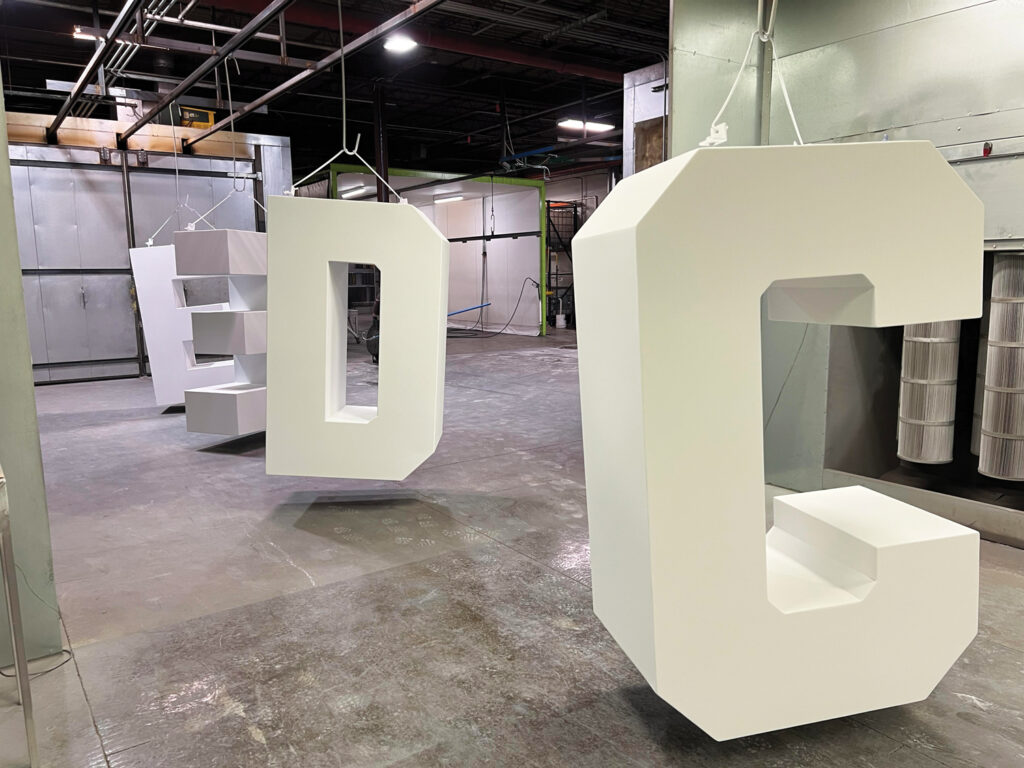
“Our projects are generally larger and often require painting and/or touch-up in the field,” says Carroll. Hoover can easily paint large areas and structures on-site. Its ESP machine is about the size of a large pressure washer, although he says the machines can range from industrial size to smaller sizes. Once the company determined it would offer ESP, it chose to paint only its own products and currently has two full-time employees who paint.
Reed, with a handful of employees, coats for all sorts of industries and products. Morse says, “We’ve got customers making construction vehicles, industrial machines, burial urns, exercise equipment, motorcycles, a variety of architectural products and all sorts of random projects.”
The company also paints items such as patio furniture, radiators, yard art, and bumpers and roll cages for vehicles. “We just coated a ski-lift chair that someone made into a bench,” he says. “You’d be surprised at what people are creating at home.”
Reed shares a building with Ohio Awning. As a priority customer, Ohio Awning can roll an awning frame to another part of the building, slip it into a gap in the schedule and grab it a few hours later.
Another benefit for Reed and Hoover has been expanded color palettes. ESP uses liquid paints, which gives Hoover a nearly limitless assortment of colors. It offers eight standard colors to customers, with an up-charge for custom colors. Reed clients can choose from a broader and more sophisticated selection, with colors including champagne metallic rather than the basic black, green or tan available before the business started doing its own coating.

The right time to expand
Whether a business decides to expand into powder coating or ESP, it’s important to consider the startup costs along with factors that are specific to its shop: the volume of its demand for coating, how much it outsources and the physical space needed to expand. Area competitors are a consideration and a potential barrier. Reed is in a market served by only a few players, and Ohio Awning regularly uses powder coating services.
“We had the available space in the building, which was probably the biggest driver in our decision,” says Morse. “We were outsourcing enough powder coating to make it a reasonable return even if we were the only customer. An additional stream of revenue outside the core business was also attractive.”
His business spent upward of $750,000 on the building setup, the equipment and installation. Depending on the size and options, Morse estimates a business could easily spend several million dollars to set up a line. Used equipment can help minimize initial costs.

ESP startup costs are significantly lower than for powder coating. Carroll says, “Any size business that uses aluminum or steel framing can easily branch into ESP with a $20,000 investment. The smaller initial investment, need for less physical space and the ability to touch up projects in the field influenced our decision to invest in ESP.”
From the beginning, Ohio Awning planned for Reed to be a separate company that would also service outside customers. “A separate entity allows us to cleanly see what we’re doing, keeps our books tidy, and we have a bit of independence in the marketplace,” Morse says.
He adds, “Being closer to the powder coating process has grown the scope of what we can do. It also exposed us to companies that work with metal in different ways than we do, which has given us a resource network that can help us on projects.”
Hoover also gained cost savings, a much quicker turnaround and an upgrade for customers. “Being able to repair in the field cuts our costs and leaves customers satisfied,” Carroll says.
Linda McDonald is a freelance writer based in Minneapolis, Minn.
SIDEBAR: Best practices
Expanding into powder coating or electrostatic painting (ESP) may be beneficial for an awning company. Whichever application method a company chooses, these lessons learned may help.
Expand slowly
Reed Powder Coating, Cleveland, Ohio, painted solely for its sister company, Ohio Awning, for nearly a year before it expanded to external customers. “We figured if we were going to mess up somebody’s work, it might as well be our own,” says William Morse, president, Reed and Ohio Awning.
Initially, Hoover Architectural Products in Fort Lauderdale, Fla., offered ESP only as a subcontracted service before it fully committed three years ago to ESP. The company’s work keeps it busy all day, every day, without adding external customers, says Matt Carroll, Hoover president.
Understand the project
To avoid underestimating, fully understand the project before taking it on. Reed coated square plates 4 feet on each side for robot machinery; however, a missed detail was that those plates were 2-inch-thick solid steel. Morse says they were too heavy to handle easily and safely, and it seemed to take three days for the parts to cool down after coating.
Know the surroundings
ESP requires air filtration or open air to apply paint. Because the machine is mobile, Hoover can paint in its shop or at a jobsite. Carroll has one caveat for painting outdoors, which is, “Don’t paint outside on a windy day or anywhere near cars.”