 TEXTILES.ORG




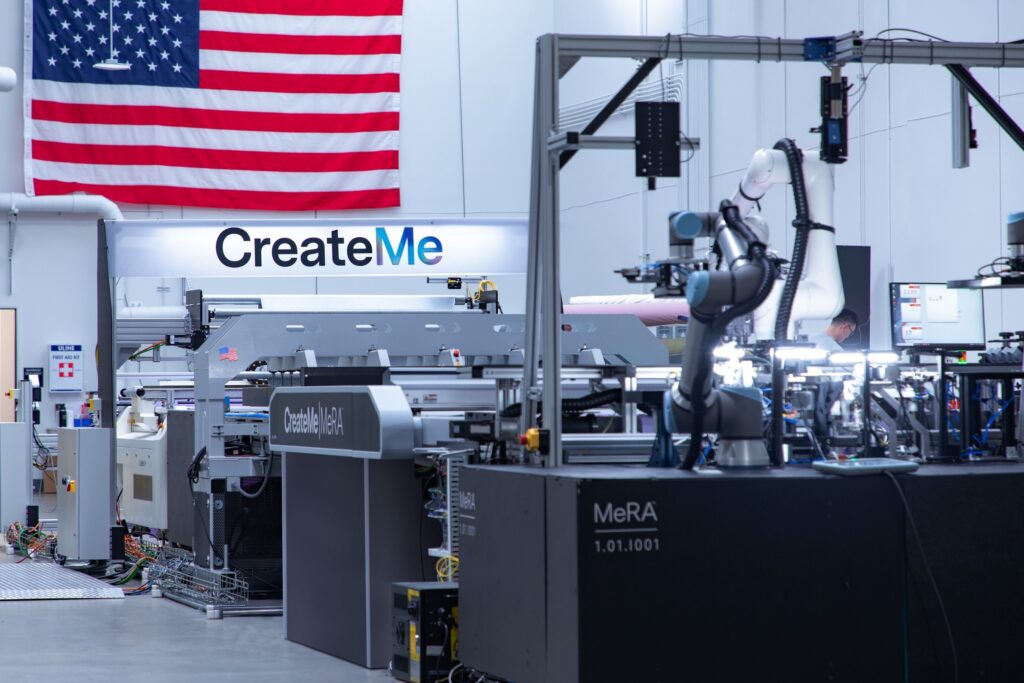
Could on-demand automated no-sew apparel production bring some manufacturing back to the United States? CreateMe’s automated system integrates robotics and adhesives to enable fast, local and highly customizable production. The company’s Modular-engineering Robotic Assembly system, called MeRA™, debuted this past fall using its proprietary micro-adhesive technology Pixel™.

“This is not automation for automation’s sake,” says Nick Chope, chief engineer and head of manufacturing at CreateMe in a release about the technology. “It’s automation built for how clothes should be made: customized, precise and close to the consumer.”
Its first product was in women’s intimate apparel. The system for that product runs end to end without human assistance. T-shirt production requires some operator input at certain assembly points. Printing or decoration would be additional steps.
On Feb. 19 the company announced its partnership with UNTUCKit for a men’s T-shirt to be made with Supima® cotton. Plans anticipate scaling up to 50,000 shirts per year beginning in the third quarter of this year.

The micro-adhesive creates bonded seams less than a millimeter wide, giving garments a “seamless” feel to the wearer. Being bonded instead of sewn eliminates thread and seam tape and supports end-of-life recyclability by allowing materials to separate cleanly.
The company says the automated T-shirt system needs only 1,200 square feet and expects to compete with offshore manufacturing because its production speeds are 20 times faster than manual sewing. Without offshore labor, speed to market could be reduced from months to days, also eliminating the carbon emissions used to transport products around the world.

Automotive seating and furniture are also in the company’s sights. CreateMe has had inquiries about capabilities with automotive soft goods handling, especially following tariff announcements in April 2025. It is seeking early engagement development partners with expertise in technology development and new product introduction as well as licensing. These partnerships will be critical in advancing technical textiles and accelerating adoption in these segments, says Cam Myers, CreateMe CEO and founder.
The company was recently accepted into the NVIDIA Inception Program, a community of startups.
Personnel news
In December the company announced the promotion of Nick Chope to chief engineer and head of manufacturing and Natasha Chand to executive advisor.
In this new, expanded role, Chope will focus on accelerating the development of next-generation physical AI tools that teach robotic systems to see, grasp and manipulate fabrics. He has more than 20 years of experience in robotics, automation and apparel—including roles at Apple, Microsoft and Tegra, and nearly five years with CreateMe.
Natasha Chand joins as an executive advisor, having served as the former global CEO of Amazon Softlines Private Label (apparel, footwear and accessories) and as a former board member at HanesBrands.
Story updated Feb. 19 with the UNTUCKit news.
See Specialty Fabrics Review‘s Swatches section every month for short stories covering news, ingenious projects and research.