 TEXTILES.ORG





Among the factors that have made the U.S. a superpower are its investment in R&D and contributions from highly skilled foreign nationals in scientific fields. The innovation borne out by this funding—as well as policies promoting domestic manufacturing—eventually influences home markets for textile manufacturers and the U.S. workforce and is essential to the U.S. textile industry.
Recent funding
Over the years, Congress has shown bipartisan support for investments in science and technology through appropriations
bills that allocate money for departments such as NASA, the National Science Foundation and the National Institutes of Health. These departments and acts fund projects at universities and other public-private partnerships. During this Congress, legislators have continued to support R&D investments by funding many departments at higher levels than the president had requested
in the FY 2026 budget.
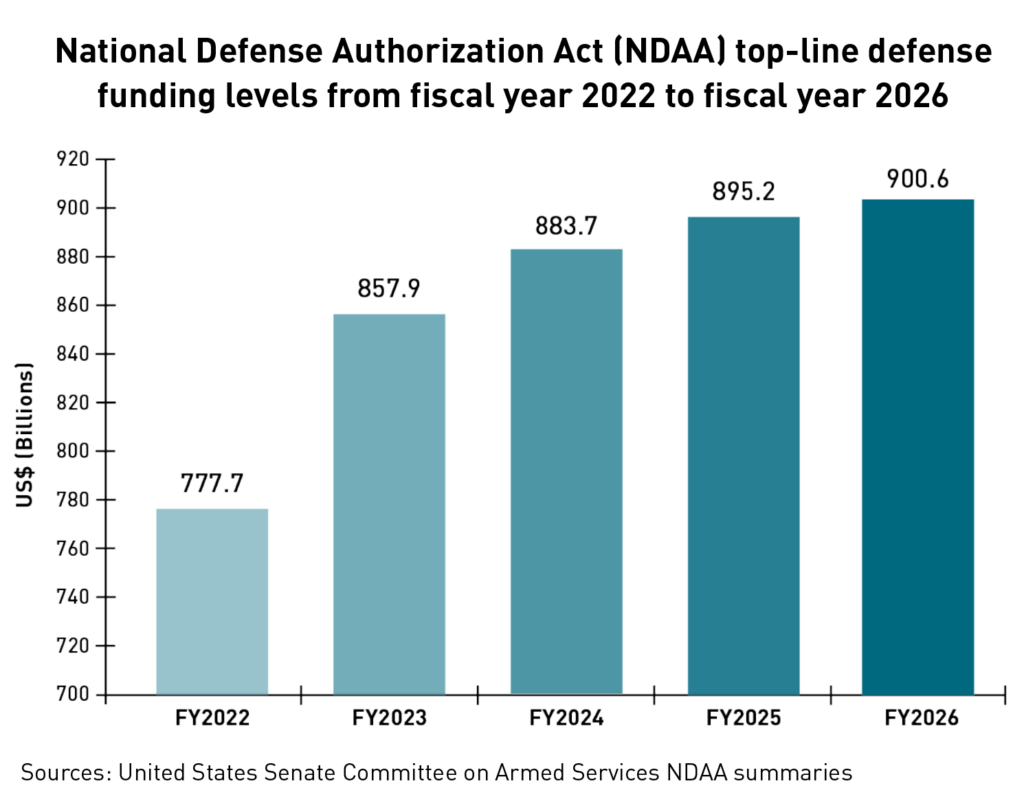
In addition to science and technology funding, the other major appropriation that affects the materials and advanced textiles industry is the National Defense Authorization Act (NDAA). As the NDAA funds national defense and security-related efforts at the Department of Defense and Department of Energy, it receives bipartisan approval. In December 2025, the president signed the NDAA conference bill into law, with total FY 2026 funding of $900.6 billion, slightly higher than his budget request. Compared with the FY 2022 enacted level, FY 2026 funding has increased by approximately 16% from $777.7 billion to $900.6 billion.
Government investments such as Small Business Innovation Research and Small Business Technology Transfer programs have enabled the development of high-tech textiles such as those used in spacesuits, emergency responder kits, fighter-plane components, parachutes and other products. As most of these textile products fall under the radar of defense research and procurement, the funding climate was expected to be supportive.
In addition to efforts such as the annual Advocacy Days hosted by the U.S. Industrial and Narrow Fabrics Institute, a group of Advanced Textiles Association, the smart textiles segments of the industry need to stay actively engaged with elected representatives to help increase funding for R&D and manufacturing in the years ahead.
The future is in advanced and smart textiles
Tariff situations, nation-first policies by many governments and changing geopolitical scenarios will likely support the growth of high-tech defense and allied industries. Companies need strategic planning, diversification and capacity building to develop and manufacture products that are used in national defense and
health care.
Several textile products could fall into the category of smart textiles or may have a peripheral but potentially significant relationship with smart materials, which could see growth, including:
- Health monitoring textiles
- Threat-sensing defense textiles
- Sustainable-fiber-based military clothing
- Next-generation active spacesuits
Since the COVID-19 pandemic, various medical textile products have received more national attention, as the public has become aware of the critical importance of personal protective equipment (PPE). In September 2025, the Department of Commerce initiated a Section 232 national security investigation on the imports of PPE, medical consumables and medical equipment.
A recommendation from the Department of Commerce, based on public feedback, is expected by May 2026. This should reveal any weak spots in the supply chain of these life-saving products, their quality and adherence to standards on imported products.
The American Medical Manufacturers Association has emphasized the need for resilient domestic manufacturing for medical supplies and advocated for stepping up domestic manufacturing. In the case of PPE, most items are imported; hence, any policy should not be at the expense of causing supply chain disruptions.
Tariffs also play an important role; however, there is no clear view on how the high tariffs on Chinese imports will help with reshoring the manufacturing of industrial products. Reshoring manufacturing may work in some sectors but not in all manufacturing areas. Advanced textiles manufacturing has scope, as it is functionality-based, R&D intensive, and is used in defense, health and other sensitive areas.
Government R&D investment aids industry
Smaller nations, for example Israel, South Korea and Taiwan, are leading in technology-related sectors including defense, electronics and automobiles. Strategic investments in key high-tech sectors (water recycling in Israel, semiconductors in Taiwan, electronics and automobiles in South Korea) have made these countries leading exporters in these areas.
Even though these regions witness tensions, researchers and postdoctoral scholars tend to prefer research-intensive universities for work in specific science and technology areas, such as the Technion Israel Institute of Technology. Globally, higher-education institutes such as Massachusetts Institute of Technology, Cambridge University, Oxford University, Stanford University, National University of Singapore and ETH Zurich occupy top ranks.
As the world becomes more multipolar, there is competition for “technology might” between major powers—most notably, the U.S. and China. In the past decade, China’s investments in R&D have significantly increased, which is visible in the number of scientific papers and university global rankings. The U.S. will likely invest in defense and advanced technologies such as modern shipbuilding, semiconductors, artificial intelligence and smart materials.
Foreign-born and domestic workforces both necessary
The U.S. global standing in high-tech sectors can be attributed to an industrious and highly educated workforce, which includes many foreign-born experts. Doctorate-level computer engineering and biotechnology sectors hire such a workforce—people in R&D and production, such as computer engineers and information research scientists. Shop-floor workers in manufacturing are typically domestic with vocational education or in-house training.
There is a misconception that legal high-tech workforce immigration has replaced the shop-floor workforce. While this is debatable, an increase in productivity and the cost of manufacturing has shifted manufacturing to low-wage countries such as China and India and caused a decline in this country’s manufacturing sectors.
In terms of legal U.S. immigration rules, emphasis is based on experience, wage levels and country-specific restrictions. Many economists and pro-immigration organizations argue that such restrictions will affect economic growth. Temporary work visas, known as H1-B, have a quota of 85,000 per year, where 20,000 of those have been set aside for foreign nationals who
have earned a minimum of a master’s degree in the U.S. Compared to the doctorate-level computer and biotechnology positions, there are fewer H1-B visa applicants in the textile industry, so changes in H1-B visa policy may not affect the industry.
To stay competitive, the U.S. high-tech industry—including textiles—must develop and attract next-generation domestic talent as much as possible. In the advanced textiles sector, it is possible to hire and train U.S. citizens with qualifications in technology, basic sciences and management without heavy dependence on foreign nationals, as the requirement for such a workforce is not as high as for doctorate-level computer scientists or engineers. The textile industry must engage with academic programs to encourage students in engineering and management by offering internships as well as supporting research to engage talent at an early stage.
The next phase of creating interest and attracting people to the industry is to proactively engage with high-school students, including an outreach effort to middle schools. Student outreach at this level can create a pipeline for new and energetic talent. If such efforts are structured, the industry will not be stifled due to the unavailability
of a skilled workforce.
Seshadri Ramkumar , Ph.D., is a professor in the Department of Environmental Toxicology and The Institute of Environmental and Human Health at Texas Tech University.