 TEXTILES.ORG





Can geotextiles and geogrids help build roadways that last for 100 years—or longer? Yes, say both industry and transportation representatives, although wider adaptation may require overcoming a few bumps in the road.
While it may still be necessary to replace the surface layers of roads every few decades, whether bituminous or concrete, geosynthetics are a cost-effective solution that could help foundation layers last 100 years or longer, says Terry Beaudry, an aggregate, base, grading and reclamation engineer for the Minnesota Department of Transportation (MnDOT) in St. Paul.
“Roads fail from the bottom up and they wear out from the top down, and being able to address the surface is orders of magnitude easier, cheaper and quicker than it is to address a bottom-up failure,” says Jaye Elsey, P.E., product manager at Tensar®, a division of CMC based in Alpharetta, Ga.
Those top, visible layers, however, are what get attention—and most of the funding—says Raul Velasquez, geomechanics research engineer at MnDOT. Pavement foundation is “usually considered an afterthought,” he says. “Unfortunately, that kind of thinking comes to haunt us later because, more often than not, failures occur because you have a poor foundation.”
Organizations such as the Federal Highway Administration, National Road Research Alliance and Transportation Research Board (TRB) have been researching and promoting the concept of 100-year roads, such as through the Transportation Research Circular E-C296: Foundation Design and Construction for 100-year Pavement Systems.
But concrete and asphalt have large lobbies behind them, Velasquez says, while pavement foundation layers don’t.
What geosynthetics do for roads
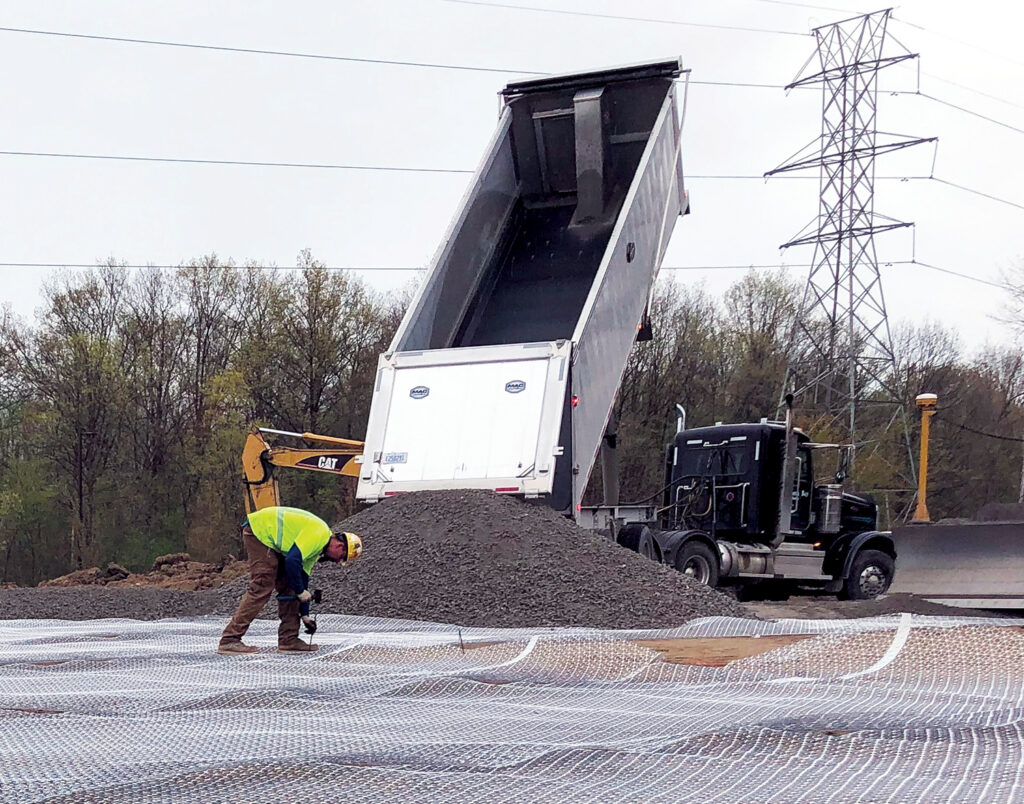
The layers involved in building a road section from the bottom up include: natural subgrade (soil), stabilized subgrade (if needed), a subbase of granular material for drainage, a base of aggregate material (often gravel) for stability and load transfer, and a top layer (asphalt or concrete). Geosynthetics are inserted among these layers for drainage, reinforcement and stabilization.
Elsey says geogrids work “by confining and immobilizing aggregate as much as possible, and that’s what gives your road section strength.” Heavy traffic, including the weight of electric vehicles, requires increased capacity.
Geogrids that can deal with non-uniformly shaped aggregate can contribute to sustainability efforts, since recycled material, including reused concrete and asphalt millings, tends to be more variable. For example, Tensar makes H-Series™ and InterAx® geogrids with multi-shape apertures that provide confinement to a variety of aggregate.
A geosynthetic underlayer beneath the new asphalt in a full-depth asphalt reclamation project greatly extends the pavement’s life, Elsey says. For less extensive repairs that replace only a couple top inches of asphalt, pavement interlayer products can provide a waterproofing membrane and prevent cracks in the remaining asphalt from reflecting into the road’s surface, he says.
Geosynthetics can also be used as a separation layer between natural subgrade and granular base. This “super simple concept,” Velasquez says, maintains the integrity of both layers and increases performance.
For projects with “decent,” non-sandy soil, Beaudry says he generally recommends a nonwoven geotextile as a separator to prevent soil from migrating up into the subbase or base layers. A 12-ounce nonwoven geotextile can also provide drainage. For areas with weaker soils, he recommends woven geotextiles. Sites with high water tables prompt the recommendation of a wicking geotextile.
As for installation of these types of products, “If you’ve ever unrolled a carpet in your house, you’re half of the way there. [Geogrid is] a very easy install,” says Elsey.

Getting geosynthetics into roadway designs
When projects in the construction phase run into a problem—for example, poor soil and a high water table—Beaudry advises fixes in the field, which usually incorporate geotextiles or geogrids.
By the time such fixes occur, the competitive bid stage for the project has passed, and MnDOT is already working with a designated contractor. The desired fabric may not be available without a delay. “So it costs time and money,” Beaudry says, not to have the products incorporated into the initial design stage.
But geosynthetics aren’t incorporated into more roadway designs at the initial design stage because quantifying geosynthetics’ benefits at that point is still a bit tricky, Velasquez says. Estimating the engineering properties of the soil-geosynthetic system can be difficult. Complicating matters further, soil samples sometimes aren’t taken at the correct location, or the soil and water table may vary at different locations within the same project site. “Mother Nature is complicated,” says Velasquez.
It’s also important to identify the correct geosynthetic, with the correct features, for a specific problem, says Ceren Aydin, a geomechanics research engineer at MnDOT. “There are actually so many geosynthetics, it’s kind of intimidating,” she says. Sometimes, says Beaudry, contractors use the wrong geotextile for a situation, either due to human error or an attempt at cutting costs.
One resource Tensar offers is Tensar+™, a free web-based design software that determines a pavement’s traffic capacity in terms of equivalent single axle load (ESAL) for a variety of products. One ESAL is equivalent to one 18,000-pound axle.
The software calculates both unit and project cost. “Taking in consideration the cost of the geosynthetic and the gravel, asphalt or concrete, if you’re able to find that sweet spot where you’re spending the same amount of money or less and getting the same or more traffic capacity, that’s engineering for value,” says Elsey.
Some municipalities have incorporated geosynthetics into their roadway standards, and “designing for value” is also popular with private developers, Elsey says, “because the financials make sense.” In a large development, even considering the cost of a geogrid, “You only have to save a dollar or two a square yard in gravel costs to save hundreds of thousands of dollars, if not millions,” he says. The final figure depends on the size of a given project and site conditions.
As for the development of widespread specific standards, states may be loath to do this, to avoid incorporating bias for one company’s product over another.
Independent evaluation could aid adoption
Complications in adoption of geosynthetics involve testing. First is the lack of independent validation of manufacturers’ own product testing. State and federal agencies take the view of “‘We cannot just trust you,’” Velasquez says. “‘We need to do our own test.’”
It would also be helpful to public agencies such as departments of transportation, says Velasquez, if the industry could accelerate the development of testing standards that incorporate both the geosynthetic and the aggregate as used in the field, since performance testing of the product can only go so far to predict how products will perform.
Elsey says, “There’s not really any correlation between ‘in-the-air’ tests, like tensile strength, to predict performance. It has to be in situ testing.”
For its part, Tensar conducts accelerated pavement testing in cooperation with the Army Corps of Engineers and other research institutions. That entails building road sections then having heavy-vehicle simulators mimic the number of loads a road would experience.
In general, performance testing of products in place is logistically difficult to conduct, especially project by project at those initial design stages. Independent evaluations of testing could lead to more geosynthetics use in these projects.
An example of an independent evaluation process of companies’ research and testing is the Innovations, Developments, Enhancement and Advancements program, also known as IDEA. The program, overseen by the Geotechnical Institute, is primarily used to evaluate mechanically stabilized earth (MSE) retaining wall systems. States then can consider the organization’s evaluation reports to approve particular systems.
The road forward
How the industry works to communicate and quantify geosynthetics’ benefits is a work in progress, but some things are certain: People continue to drive, and infrastructure projects don’t ever get cheaper.
Pavement surfaces inevitably require replacement or repair. But that doesn’t have to be the case for the layers underneath when designed and constructed to retain support through time, says Elsey. It’s much less time-consuming and materials-intensive (and less expensive) to resurface the top layer than to reconstruct the entire foundation, with less impact on the public and reduced congestion. Through the use of geosynthetics in the foundation, he says, “It’s definitely possible to have ‘perpetual’ pavement.”
Joanna Werch Takes is a writer and editor based in Minnesota.
Are geosythetics and geotextiles your market? Check out the Geosynthetics Materials Association for shows, resources and advocacy efforts on behalf of the industry.