 TEXTILES.ORG




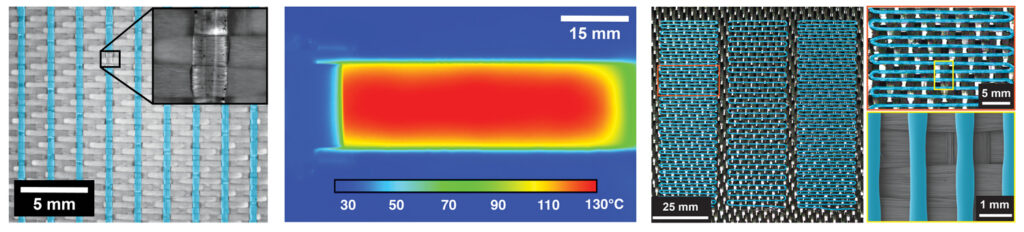
Researchers at North Carolina State University (NC State) have developed a self-healing composite that is tougher than materials currently used in aircraft wings, turbine blades and other applications and can repair itself more than 1,000 times.
The scientists worked with fiber-reinforced polymer (FRP) composites, which are valued for their high strength-to-weight ratio and are commonly used in aircraft, automobiles, wind turbines, spacecraft and other modern structural applications. The technique developed by the researchers targets interlaminar delamination, which occurs when cracks within the composite form and cause the fiber layers to separate from the matrix.
The self-healing material resembles conventional FRP composites but with two additional features. First, the researchers 3D-print a thermoplastic healing agent onto the fiber reinforcement, creating a polymer-patterned interlayer that makes the laminate two to four times more resistant to delamination. Second, the researchers embed thin carbon-based heater layers in the material, which warm when an electrical current is applied. The heat melts the healing agent, which then flows into cracks and microfractures and re-bonds delaminated interfaces, restoring structural performance.
To evaluate the composite’s long-term healing performance, the team conducted 1,000 fracture-and-heal cycles over 40 days, measuring delamination resistance after each repair.
In real-world scenarios, healing would be triggered after the material is damaged by hail, bird strikes or other events or during scheduled maintenance. The researchers estimate the material could last 125 years with quarterly healing or 500 years with annual healing.
Jason Patrick, the paper’s corresponding author and an associate professor of civil, construction and environmental engineering at NC State, has patented and licensed the technology through his startup company, Structeryx Inc.