 TEXTILES.ORG




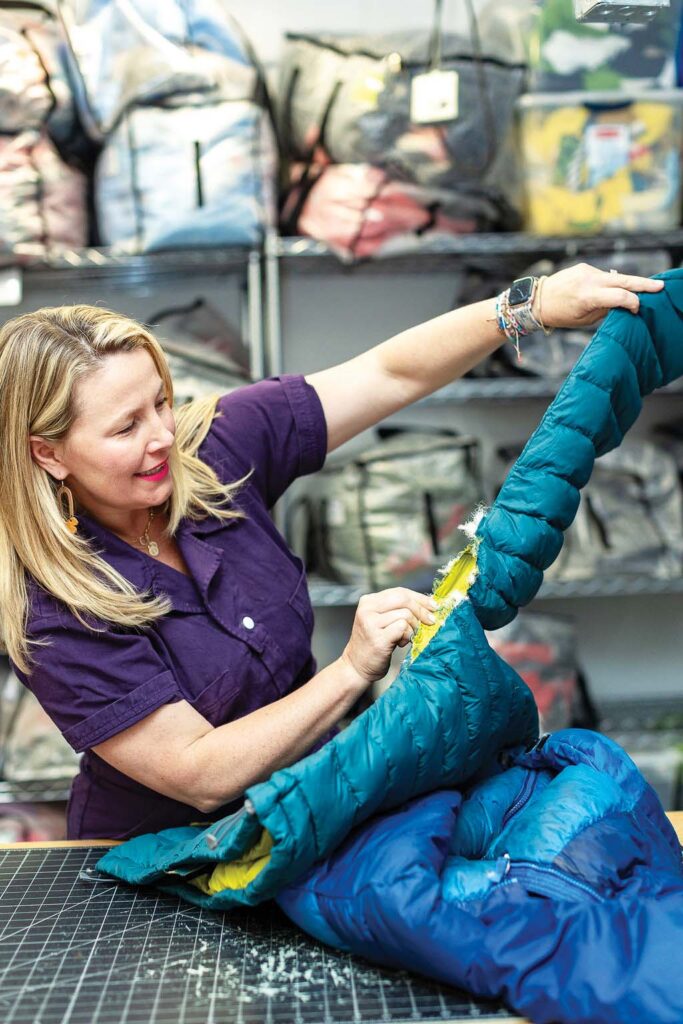
A mishap one day on the slopes led to Kate Harvey founding the Morrisville, Vt., textile re-manufacturing business BirdieBlue. The company takes damaged outdoor gear and upcycles it into bags, keeping durable performance textiles out of the waste stream. The products are often resold in the same resort shops and stores as supplied the company with the damaged gear in the first place, through take-back programs.
What follows is a conversation with Harvey, edited for length.
Tell me about your entrepreneurial background and your sewing/design background.
BirdieBlue is actually my first business. Before becoming an entrepreneur, I spent my career in television journalism and talent strategy. I didn’t come out of the textile industry, and I’m not a trained designer or sewist, which shaped the way I’ve built BirdieBlue.
The idea started in 2020 when I ripped my favorite ski pants while skiing with my son and ended up skiing down the mountain with my rear end hanging out. I couldn’t bring myself to throw them away, so I started looking for a way to recycle them. That search opened my eyes to how … technical outdoor gear is among the hardest textiles to recycle because of its mixed materials, waterproof membranes, coatings, insulation, zippers and hardware.
I started experimenting with turning old gear into something useful instead. I worked with people who understood sewing and construction, learned an enormous amount about textiles and manufacturing along the way, and eventually developed what became our first products. After realizing we had proof of concept, I decided to leave corporate America and launch BirdieBlue.
I sometimes joke that not knowing all the “rules” of textile manufacturing was helpful. I looked at an old ski jacket and thought, “Why can’t this become a bag?” Then we had to figure out how to actually make that happen at scale.
Tell me about the company’s growth over the last four years and the resulting challenges.
BirdieBlue started in my garage and has grown into a company working with outdoor brands, ski resorts, retailers and recycling partners including Stio®, Burton, Stratton Mountain, Sugarbush mountain, Turtle Fur®, REI® and the U.S. Ski Team. We’ve now diverted more than 20,000 pieces of outdoor gear and textiles from landfills and built a network of more than 20 Vermont-based sewists.
One of the biggest shifts has been realizing that BirdieBlue isn’t simply a consumer bag company. We want to be the upcycle partner for the industry, helping manage end-of-life gear. We’re building infrastructure that can help the outdoor industry deal with materials that are extremely difficult to recycle.
As our partnerships have grown, materials now arrive by the pallet as well as by box. That creates a completely different operational challenge: receiving, sorting, cleaning, deconstructing, cataloging, cutting, storing and ultimately manufacturing thousands of inconsistent pieces of material.
Traditional manufacturing starts with predictable rolls of fabric. We might start with 500 ski jackets, and every single one is different. Scaling a manufacturing system around that variability has probably been our biggest challenge and one of the things I’m most proud of figuring out.

Tell me about your fabricators and production location.
Our studio in Morrisville, Vt., which we call “the Nest,” is our central hub. That’s where materials arrive and are sorted, washed, deconstructed, cut, prepared for production and ultimately fulfilled.
From there, we work with a network of more than 20 sewists, many of whom sew from their homes throughout Vermont. The model allows us to create skilled manufacturing work while offering flexibility that can be particularly valuable for women balancing children, caregiving, farming or other jobs.
As we’ve grown, we’re also building more production capacity inside the Nest. The goal isn’t to replace our home sewist network but to create a flexible manufacturing ecosystem that can grow with us.
How does your gear come in to you?
In the early days, gear primarily arrived one piece at a time through our own consumer upcycling program. Today, we receive everything from individual packages to boxes and pallets from brands, ski resorts, retailers, recyclers and other partners.
Increasingly, we’re becoming a downstream solution for brands that already have take-back, repair, warranty or resale programs. Those programs do an important job extending the life of usable gear, but there is always a category of material that cannot be repaired, resold or traditionally recycled. That’s where BirdieBlue can fit.
For example, one recent partnership diverted four pallets of damaged and end-of-life gear to us. Those volumes are forcing us to think very differently about material intake and production.
How do you manage the deconstruction process?
Technical apparel was literally designed not to come apart, so deconstruction can be incredibly labor-intensive. We first sort materials based on condition, fabric type, color and potential use. Items are cleaned as needed and then broken down so we can recover the largest usable panels while removing components that interfere with cutting and sewing.
We’re very intentional about what we deconstruct. The goal is to preserve as much usable material as possible rather than breaking everything down into tiny components.
We’ve also invested heavily in improving the next stage of the process. One of our biggest equipment investments has been a clicker press and custom cutting dies. Previously, cutting 100 bags could take two or three days. With our new system, we can cut components for roughly 100 bags in two to three hours.
The deconstruction itself is still largely manual, but automation is absolutely the next frontier for us. We’re exploring ways to use technology for intake, photography, material categorization and inventory tracking. If we’re going to meaningfully increase the amount of technical textile waste we divert, we have to make the front end of this process much more efficient.
Do the resorts and brands providing raw materials also sell the resulting bags?
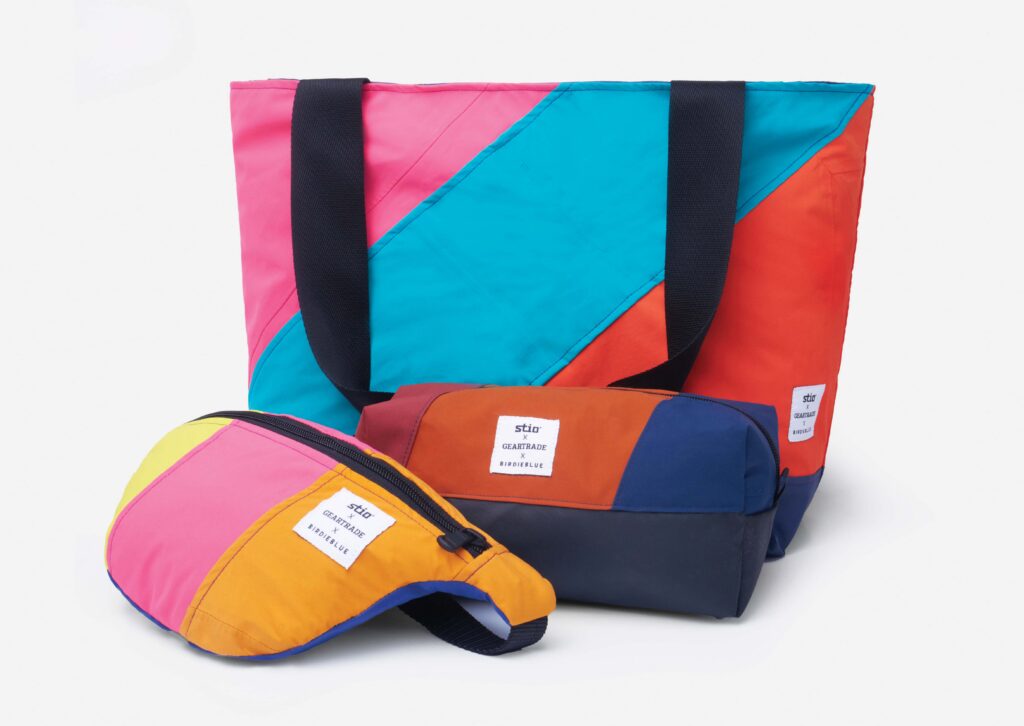
Yes, and that’s become one of the most exciting parts of our model. We create custom collections using a partner’s own retired materials and then, in many cases, those products go back into their stores or are sold through a collaborative launch.
We’ve transformed retired uniforms, patrol jackets, event banners and other materials into limited-edition collections. The customer isn’t simply buying an upcycled bag. They may be buying a piece of the mountain, team or brand they already have an emotional connection to.
For our partners, it creates a circular story they can actually put back in front of their customers. Instead of quietly disposing of obsolete materials, they’re able to show what happened next.
What do the event banners and race bibs become?
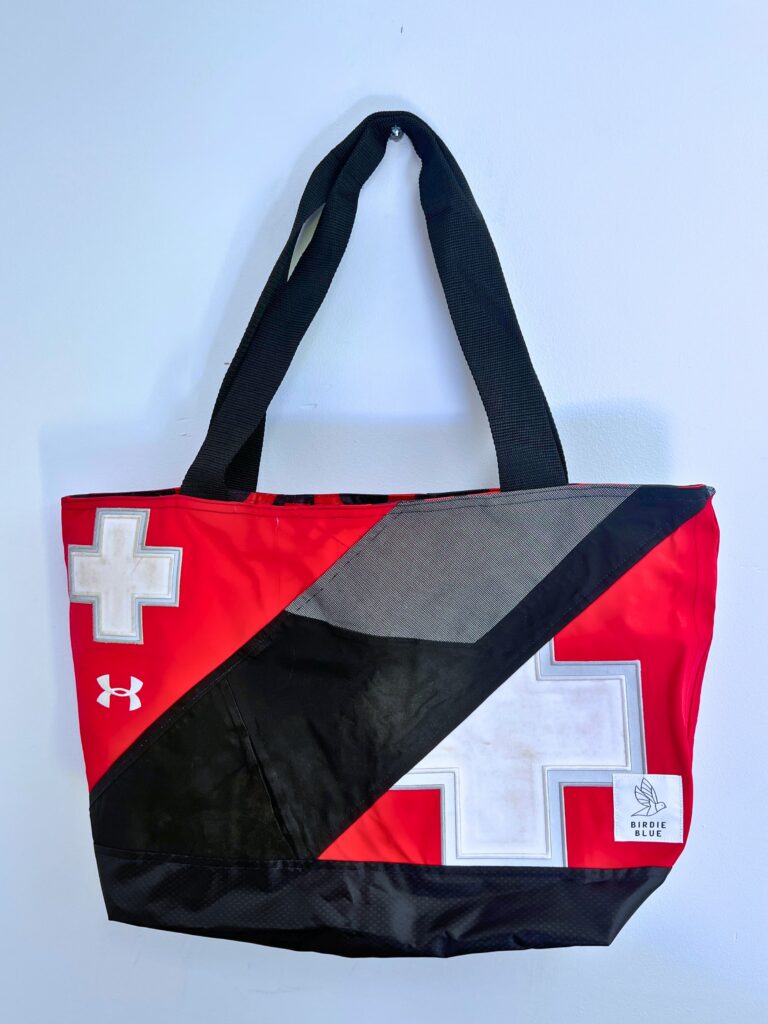
This is one of my favorite material streams because the graphics are incredible. Event banners can be huge, sometimes many feet long, and are generally made from extremely durable materials intended to survive outdoors. We use them especially for components that benefit from that durability. One of our signatures, for example, is using reclaimed banner material from the U.S. Ski Team on the bottom of our Carry All bags, which gives them a durable, water-resistant base.
We’ve also created bags where the banner itself becomes the visual centerpiece. We recently worked with Vermont Green Football Club, based out of Burlington, Vt., to transform banners that hung in their stadium into a limited run of Carry Alls. Logos, lettering and pieces of graphics become completely unique design elements.
We’ve worked with Nordic ski race and coach bibs, among other event materials. Their numbers, sponsor logos and graphics can become amazing storytelling elements in a finished bag.
That’s one of the things I love most about upcycling: We’re not trying to disguise where the material came from. We want you to recognize it.
Does any gear ever look too good to take apart?
Absolutely, and we don’t want to destroy something that still has useful life left in it. Our philosophy is that reuse should come before upcycling whenever possible. If something can still be worn, repaired or resold, that is generally a better use of the product than cutting it apart.
That’s also why partnerships with resale, repair and take-back programs are so interesting to us. BirdieBlue can become a solution for the materials at the very end of that hierarchy: the jacket with the broken zipper and torn sleeve, the obsolete employee uniform, the warranty return that can’t be repaired or the technical textile that has no viable recycling stream.
We don’t need the good stuff. Give us the weird, broken, damaged and otherwise unusable stuff! That’s where we can add the most value.
How much joy does this recycling mission bring to you?
There is something incredibly satisfying about looking at a pile of material someone considered waste and seeing possibility instead. But the part that brings me the most joy is that the impact keeps multiplying. We’re keeping difficult materials out of landfill, creating manufacturing jobs for women, helping outdoor companies solve a real waste problem and making products that people genuinely love carrying. And these materials already have stories. A ski-patrol jacket has been on a mountain for years. A race bib has crossed a finish line. A banner hung at an event where thousands of people cheered. We get to give those stories another chapter.
I never expected a ripped pair of ski pants to lead me here, but four years later, I still get excited every time a new pallet arrives at the Nest because I immediately start wondering, “What can we make out of this?”
What’s next for BirdieBlue?
The next chapter is really about scale. We’ve spent the last several years proving that people want these products and that brands and resorts need better end-of-life solutions for technical textiles. Now we’re building the manufacturing infrastructure to handle much larger volumes. We’re investing in equipment, cutting technology, production systems and material tracking; expanding our network of manufacturing partners; and developing more partnerships with outdoor brands, resorts, recyclers and other textile companies.
Long term, I want BirdieBlue to help demonstrate that circular manufacturing can work commercially at scale. Outdoor companies shouldn’t have to completely retool their own supply chains or build complicated recycling systems to deal with every piece of end-of-life material. We are not a competitor. We collaborate with brands and become part of that solution.
The bigger BirdieBlue grows, the more material we can divert, and that’s the metric that continues to motivate me.
Check out cutting-edge research, projects, mini features and art in the Swatches section of Specialty Fabrics Review each month.