 TEXTILES.ORG





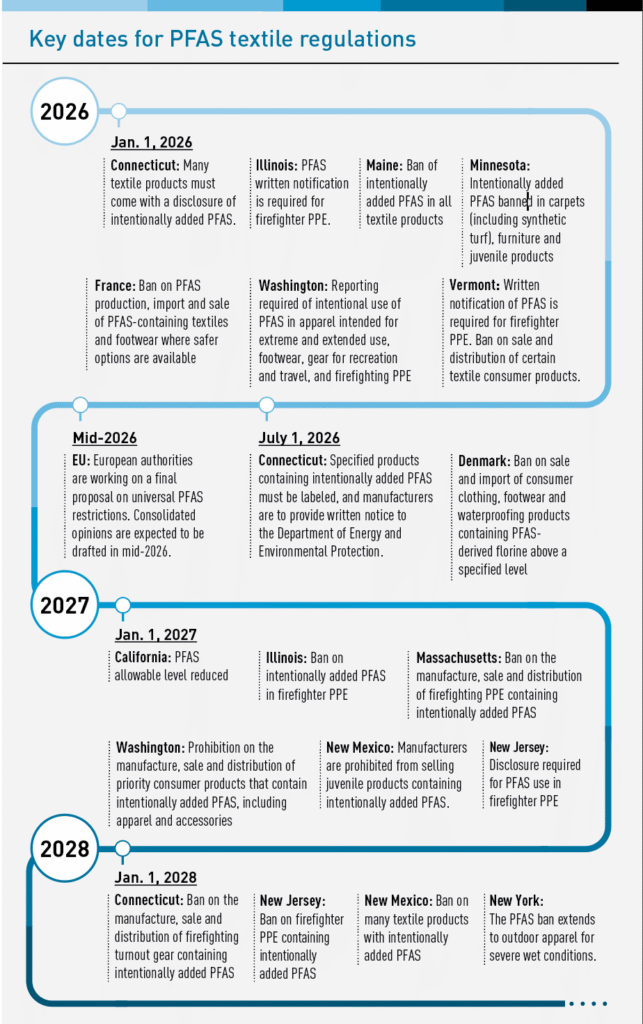
Many jurisdictions have current and forthcoming regulations banning per- and polyfluoroalkyl substances (PFAS) in a variety of products, including textiles. Laboratory testing can help prove compliance with such bans of these so-called “forever chemicals,” although not without some caveats and complications.
Despite what some lawmakers may wish, “From a technical standpoint, ‘PFAS-free’ or ‘PFAS not intentionally added’ is not a measurable standard,” says Mitch Koffel, vice president of sales at Claros™ Technologies Inc., based in Minneapolis, Minn. “Without a defined threshold, compliance becomes ambiguous for the entire supply chain.”
When advising companies on what level of PFAS concentration to test for, Stacey Bowers says it’s important to take the location of their distribution markets into account. Bowers is global product compliance manager at Enhesa, a company focused on regulatory and sustainability intelligence and compliance, with a U.S. office in Arlington, Va., and worldwide headquarters in Brussels, Belgium. “My job is to help people understand where and how their products might be regulated,” she says.
Bowers says California often functions as a bellwether for chemical legislation. Following its regulations can be helpful to avoid creating a separate product for other states, but companies also need to consider additional jurisdictions with current or proposed PFAS bans.
Often, Bowers says, testing labs will create a geographic protocol focused on a region, such as North America, to encompass the majority of or most restrictive regulations in that area.
Finding a lab, choosing tests
Part of the complexity of testing is the number of PFAS compounds—more than 15,000—says Beryl Xia, director of analytical at ClarosLabs™ and current chair of the American Association of Textile Chemists and Colorists committee on PFAS. “Some tests screen broadly for all fluorine, which is too general. Other tests look for 40 or 100 specific compounds. Right now, no single test exists that can find all 15,000-plus PFAS species and only PFAS,” Xia says.
Total organic fluorine (TOF) testing—the measurement used in regulations such as those in California—is a very broad screening tool, says Xia. “It looks for all fluorine in any chemical compound, not just the fluorine in PFAS.”
However, says Colleen McLoughlin, director of toxicology and interdisciplinary sciences at Enhesa, TOF “won’t tell you which PFAS are present, but it’s the marker that gives you a baseline.”
The methodology for total fluorine testing can include surface testing of samples via particle-induced gamma emission spectroscopy, which involves measuring gamma rays emitted from samples exposed to proton beams. It can also involve combustion ion chromatography, in which samples are burned and the resulting fluoride, extracted from compounds such as PFAS, is measured. Nuclear magnetic resonance testing, which measures differences in molecules after exposure to a magnetic field, is also an option.
All these methods work, according to Xia, but they aren’t interchangeable. They differ in cost, preparation time and, most important, fluorine detection levels. “The right test depends on what the company needs to prove. Is this for a sustainability claim to build customer trust, or is it to comply with a specific law? The ‘why’ determines the ‘what’ in testing,” she says.
Beyond regulatory compliance, companies may choose to pursue PFAS testing in order to receive specific certifications or, says Koffel, “to leverage verified results as a powerful marketing benefit to build consumer trust and assure source of supply.”
Typically, says McLoughlin, a textile company looking to have its products tested should search for a lab that is International Organization for Standardization-certified in the specific test it’s looking to conduct.
Testing for OKEO-TEX® Standard 100, a voluntary certification for textiles that declares them harmless to human health and compliant with EU regulations, now incorporates alkaline hydrolysis testing. Alkaline hydrolysis uses a mixture of methanol and sodium hydroxide (also known as lye) to break down textile treatments such as polymers and find PFAS that previously might have been contained within the polymers. An April 2025 update to the European Union’s (EU) standards for testing PFAS in textiles added alkaline hydrolysis as part of the liquid chromatography-mass spectrometry (LC-MS) process.
LC-MS can measure specific PFAS compounds based on their known mass. The process separates chemical compounds into components within a liquid and measures the sample’s ions to determine their ratio of physical mass to electrical charge.
When choosing a lab, McLoughlin says, companies should consider its location, which may affect shipping costs and shipping regulations. For example, acetic acid, used in textile dyeing and finishing, is classified as a dangerous good and subject to stringent shipping regulations.
Since PFAS is a current challenge across all industries, adds Bowers, some labs specialize in PFAS testing for items such as cosmetics, cookware or plumbing fittings. Textile companies will want to look for a lab with the ability to conduct tests on textiles.
Textile industry representatives who might commission PFAS testing from a lab, Koffel says, can range from dye mills and garment manufacturers to retail stores.
Unexpected PFAS may result in ‘detective work’
Testing, plus documenting the lack of intentionally added PFAS, is a good idea for companies, says Bowers. Testing might identify PFAS exceeding desired levels coming from unexpected sources.
“Finding out where it’s coming from can be some detective work,” McLoughlin says. “We’ve seen customers who have ruled out intentional use in their supply chain and have to focus more on process chemistries or potential areas of contamination.”
For instance, she says, one company eventually found the source of PFAS contamination to be a lubricant used on its equipment that was transferring to the fabric. “They knew it wasn’t coming in intentionally because they’d done other work with their suppliers to confirm that. So they had to start to look at their processes and their equipment and start to test in different phases” to figure out the source, McLoughlin says.
During manufacturing, “If a fabric rolls over PTFE [polytetrafluoroethylene] plastic components, those parts can leach small amounts of PFAS onto the material over time,” says Xia.
“We are especially cautious with absolute language like ‘PFAS-free’ because PFAS are so ubiquitous in the global environment,” says Koffel. “The reality is, if you test virtually any material at a sufficiently sensitive detection level—down to parts per trillion—you may find trace amounts.”
He offers the textile industry an analogy of regulations impacting drinking water, which identify acceptable detection limits for perfluorooctanoic acid (PFOA) and perfluorooctane sulfonic acid (PFOS). If those limits are set too low, Koffel says, “It could render entire public water systems noncompliant. The key is finding a limit that is both protective of public health and achievable with current technology.”
For the textile industry and others, Koffel says, “We need clarity not only on what the standard is today but also a predictable road map for what it will be five years from now, as the supply chain continues to innovate and scale new, non-PFAS textile alternatives.”
Joanna Werch Takes is a writer and editor based in Minnesota.
SIDEBAR: Regulations and risk assessments
Per- and polyfluoroalkyl substances (PFAS) continue to significantly impact the textiles industry, and it’s more important than ever to stay abreast of any regulatory changes.
This was the theme of an education session at Advanced Textiles Expo last November led by Amy Berg, partner at Ice Miller LLP, and Elizabeth Denly, vice president, PFAS initiative leader & chemistry director at TRC Companies. PFAS monitoring is a tightrope to walk, especially because “PFAS” doesn’t mean the same thing in every context.
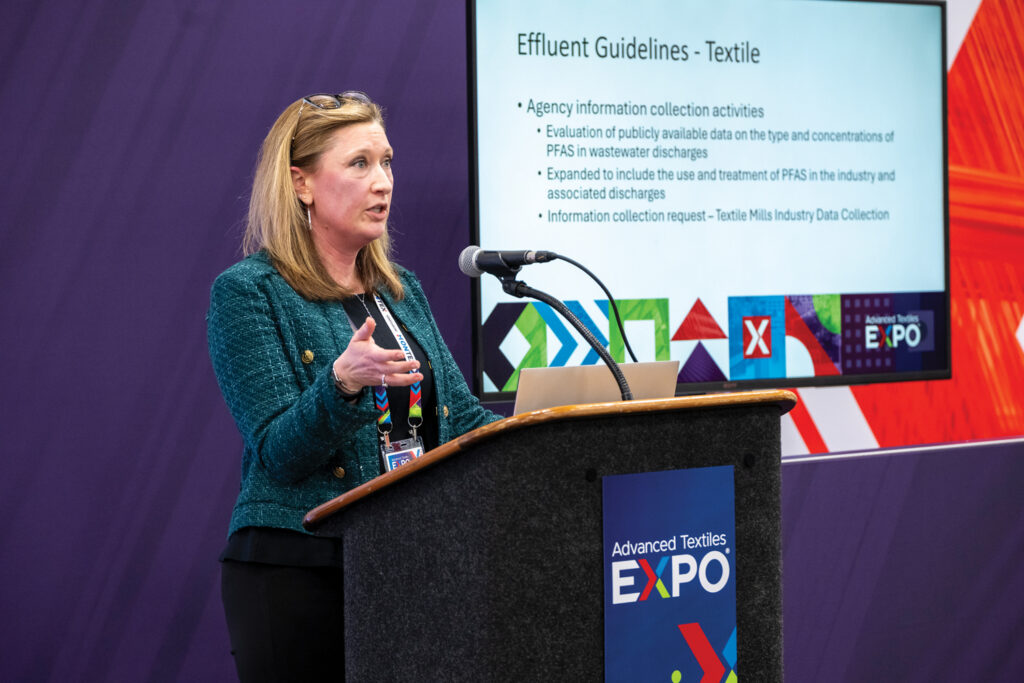
“It’s a frustrating area because the definition changes depending on who you’re working with,” says Berg. That said, any PFAS will tend to be bioaccumulative and the compounds themselves are very effective at what they do.
Among the many recent PFAS regulatory proposals Berg shared was the addition of nine PFAS to the list of hazardous constituents under the Resource Conservation and Recovery Act. While the rule is set to finalize in April 2026, Berg noted that the Environmental Protection Agency oftentimes doesn’t meet its deadlines (and last autumn’s government shutdown almost guarantees this will be the case).
Denly’s half of the presentation focused on the realities of PFAS use in textiles and how companies can manage their risk profile. Not only is there a looming concern over financial liability, but increased public awareness about PFAS can put a brand’s reputation at risk.
Among Denly’s recommendations was encouraging key decision-makers to launch a risk liability assessment/review for the business. While it isn’t urgent yet, some testing may be necessary in the future.

Companies who take on this type of project should do so under attorney-client privilege, according to Denly. However, even if someone external is assisting in a review, Denly says “the company has to be involved every step of the way.”
Information about confirmed regulatory changes and educational materials are available in Advanced Textiles Association’s PFAS Resource Center at textiles.org/education/pfas-resource-center.
Brianna Liestman is the senior editor on Marine Fabricator and associate editor on Specialty Fabrics Review. She can be reached at brianna.liestman@textiles.org.
SIDEBAR: How much PFAS is too much?
When testing products for PFAS, what is a “good” level?
California’s Safer Clothes and Textiles Act has chosen an initial limit, currently in effect, of no more than 100 parts per million PFAS, as measured by total organic fluorine (TOF) in textiles manufactured or sold in the state. The limit will reduce to 50 parts per million on Jan. 1, 2027.
New York, meanwhile, is considering a 50 parts per million TOF limit, with further limits for individual PFAS analytes of 25–1,000 parts per billion. The law prohibited intentionally added PFAS in apparel starting Jan. 1, 2025, and will extend to outdoor apparel for severe wet conditions Jan. 1, 2028.
The European Union (EU) currently prohibits most uses of specific PFAS compounds, perfluorooctane sulfonic acid (PFOS) and perfluorooctanoic acid (PFOA), through Registration, Evaluation, Authorisation and Restriction of Chemicals regulation. The EU is also likely headed toward a near-universal ban on PFAS.
Some organizations, such as the Apparel and Footwear International RSL Management (AFIRM) Group, have identified suggested best practices for their members. AFIRM’s 2025 update to its Restricted Substances List suggests a TOF limit of 50 parts per million.
Beryl Xia, director of analytical at ClarosLabs™ and current chair of the American Association of Textile Chemists and Colorists committee on PFAS, says she has occasionally experienced clients wanting to test common PFAS compounds, such as PFOA and PFOS, down to levels such as 200 parts per trillion or 10 parts per trillion. A concentration of 1 part per trillion is the equivalent of one second in 32,000 years.
“While having some limit is better than none, the truth is there’s no scientific consensus on where to draw the correct line for textiles,” says Xia.
Joanna Werch Takes is a writer and editor based in Minnesota.
Information about confirmed regulatory changes and educational materials are available in Advanced Textiles Association’s PFAS Resource Center at textiles.org/education/pfas-resource-center.
See Specialty Fabrics Review‘s Markets section in every issue for insights on what’s happening in textile markets affecting industry businesses.