 TEXTILES.ORG





Textiles for the automotive market are an exacting product segment but also one full of opportunity, whether producing materials for upholstery shops or mass-produced vehicles. Trends include achieving sustainability goals and creating novel lightweight insulating materials that need to work a little differently than before. However, this market segment also has mainstay fabrics that are tried and true.
Data matters
“The automotive market is continually evolving,” says Nash Saadah, president of sales and product development at Delaware Valley Corporation (DVC) in Tewksbury, Mass. DVC specializes in needlepunch, face-structured fabrics for vehicles, carpets and other industry applications.
“Whether a vehicle driven by a person or an autonomous vehicle, there will always be a demand for cars, for transportation,” Saadah says.
Fabrics used in vehicle applications, including seat covers, carpets and sound insulation, must pass rigorous testing for flame and chemical resistance and check all the boxes on comfort, durability and aesthetics.

Shawmut Corporation, headquartered in West Bridgewater, Mass., specializes in producing next-gen textiles and fabrics. Mollie Engel, vice president of design and development, says durability and regulatory compliance are critical for the automotive and mobility sectors. Materials must perform under stress, under environmental exposure and over time.
But it’s more than just surviving, she says. It’s about aging gracefully. “Materials need to retain color, texture and structure through years of UV exposure, temperature swings and repeated use. In luxury programs, even the slightest inconsistency can lead to materials being rejected,” Engel says.
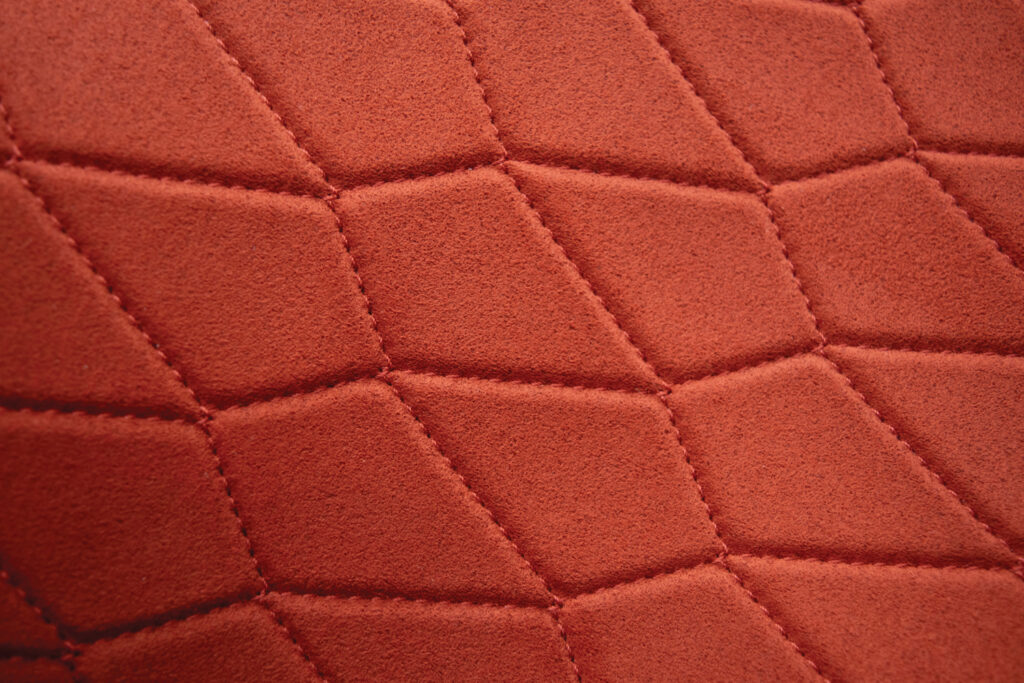
Shawmut is particularly interested in sustainable, scalable and cost-effective materials that deliver desirable visual or tactile experiences while meeting environmental goals. Engel highlights an increased interest in monomaterials and recycled-content textiles like the company’s Neoluxe™ Premium Knit Suede, which can be engineered for a multitude of automotive interior uses and is soft, lightweight and durable without the environmental footprint of traditional suede.
“We’re also seeing a growing push for authenticity—materials that look and feel luxurious but are backed by real sustainability data,” Engel says. “More brands want to tell meaningful stories about the materials they use, and they’re turning to suppliers like Shawmut to help bring that narrative to life.”
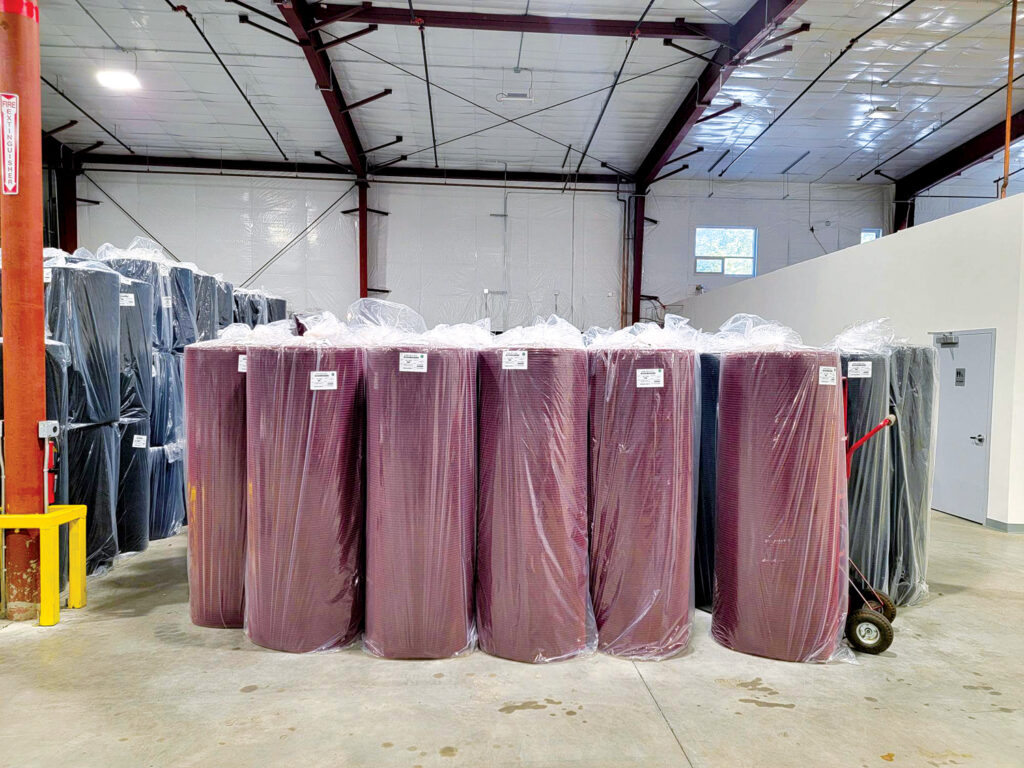
Engel says that alternative textiles, including upcycled and bio-based materials, are gaining interest across regions. And while the European Union (EU) currently leads adoption due to regulatory drivers, interest in the U.S. is growing. What’s more, she is seeing increased scrutiny around “greenwashing” tactics.
“OEMs want assurances that alternative materials truly move the needle—so traceability, third-party validation and full life cycle analysis are becoming must-haves, not nice-to-haves. For mass production, materials must still be scalable and robust,” Engel says.
Market pivots and regulations affecting automotive textiles
DVC’s culture emphasizes one-on-one relationships and long-term client/employer retention. The company’s markets include automotive upholstery shops and lower-volume car models, such as the Chevy Bolt.
“Specialization is our forte, not volume,” Saadah says. “Our strength is our size. We’re a small business owned and operated by second- and third-generation owners, and we focus on niche markets.”

Saadah says in the past 10 years, his company has shifted from the use of dyed polypropylene to rPET (recycled polyester) fabrics for automotive OEMs such as Ford, GM and Stellantis due to its cost and availability.
“The introduction of recycled polyester has balanced and minimized sourcing volatility over the last few years,” Saadah says. “There are always environmental regulations such as REACH [EU regulation Registration, Evaluation, Authorisation and Restriction of Chemicals], the California propositions, etc. But we still manage to produce products that are sustainable … and meet these requirements.”
Another thing that has helped DVC weather instability is market diversification. Saadah maintains that working with nonautomotive markets, including medical, industrial and construction, gives the company the time and ability to pivot and adapt to market changes and a “revolving door” of automotive customers.
“Our survival relies on diversity: product diversity and market diversity,” he says. “Over the years, we slowly divested away from automotive but still focused on niche automotive, small volume and then ventured into different industries that still fit our model. It’s a cycle. We learn from it.”
Shawmut’s Engel says that one of the industry’s biggest hurdles has been scaling sustainable materials for use in mass-produced vehicles.
“It’s not enough to develop something new and eco-friendly; it has to be durable, cost-effective and able to meet strict automotive specifications,” she says. “We’ve also worked hard to validate these materials under intense testing protocols. Automotive programs have long lead times, and our materials need to pass every hurdle, from odor and VOCs to abrasion and UV exposure.”
Shawmut also has had to become more nimble in how it sources and qualifies materials. A global manufacturing structure allows the team to build flexibility into its supply chain to respond to regional disruptions, tariff changes or raw material fluctuations.
“We’ve also invested in vertical integration where it makes sense—particularly around knitting, lamination and finishing—so we
can better control quality, lead times and pricing,” Engel says.
EVs influence development of automotive textiles
Saadah expects electric vehicles will dominate the automotive market within 10–15 years as battery efficiency improves and electric vehicle prices decline.
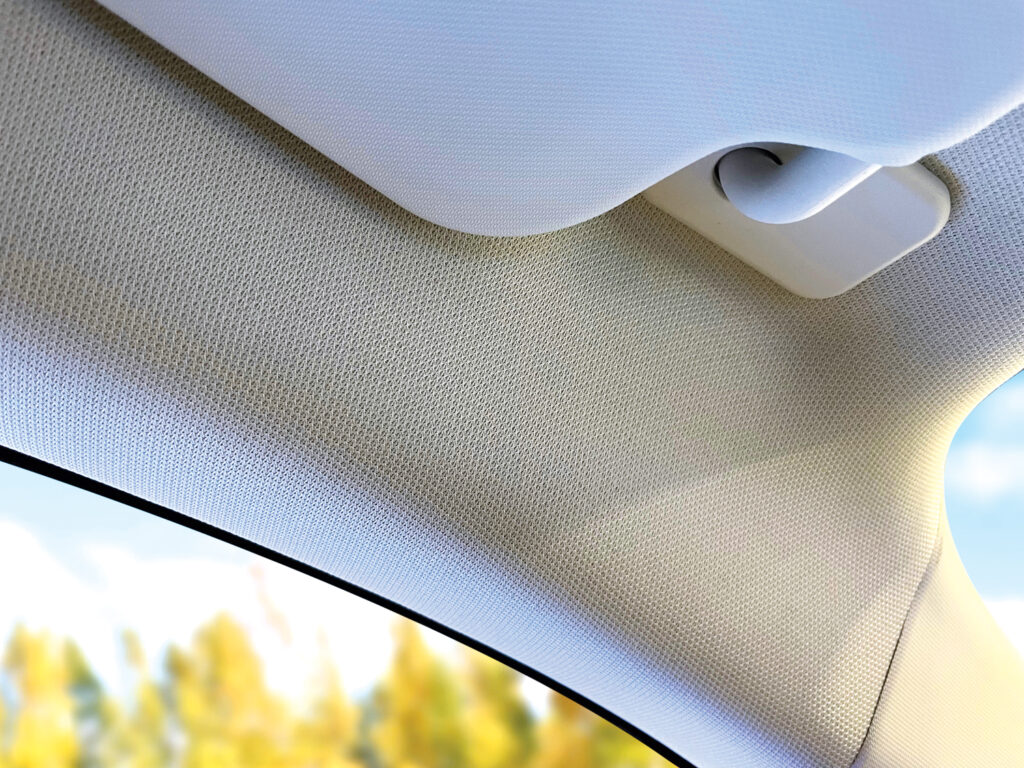
“The transition to EVs is creating demand for specialty textiles, emphasizing lightweight composites, eco-friendly materials, sound dampening and thermal efficiency,” says Saadah.
Lightweight insulative interiors could help improve vehicle range on a charge by allowing less battery energy to be used on climate control in extreme temperatures. Electric vehicle batteries themselves also operate most efficiently within a specific exterior temperature range.

He says DVC’s textile products are a good fit for EVs as they insulate while absorbing sound. Gas-powered vehicles have a combustion engine, which makes noise and generates heat through its operation; EVs by definition do not generate power or heat this way, so ambient noise is more noticeable in an EV, and warmth must be generated from the batteries. The electric components also hum at different frequencies than a petroleum-fueled engine, needing the textiles used to be adapted to that difference. And because EVs are heavier than conventional vehicles, material weight is important—all of which means opportunities for textiles.
DVC also is exploring fibers with a hollow core, often made from sustainable or recycled materials. The fibers are lightweight and provide thermal insulation—ideal properties for EV interiors as lighter materials contribute to vehicle range per charge.
Engel says in North America especially, automakers are accelerating investments in electric vehicle interiors, and they’re hungry for sustainable materials that also reflect performance and brand identity.
“We’re actively collaborating with automakers on future EV interiors that prioritize sustainability, comfort and design versatility,” she says.
Tech advancements
Saadah says DVC is transitioning its internal processes and equipment to keep pace with rapidly evolving textile technology. Staff is reviewing artificial intelligence tools that can support emerging technologies, such as sensors embedded in textiles that may one day monitor things like driver consciousness, temperature controls and other functionalities.
“Everybody is integrating existing processes and equipment with the new world and new technologies,” he says. “It’s almost like a generational shift. We at DVC were established in the 1950s and we’ve been upgrading over time. However, the market and technology are advancing quickly. It will be a challenge—and I think we can meet that challenge—but it will take time, money, effort and resources.”
Still, Saadah says he’s more optimistic than pessimistic. “I like change. I like that we will continue to evolve and everything will continue to evolve. It’s a win-win situation.”
Sara Scullin is a freelance writer and editor based in Wisconsin.
See Specialty Fabrics Review‘s Markets section in every issue for insights on what’s happening in textile markets.