 TEXTILES.ORG




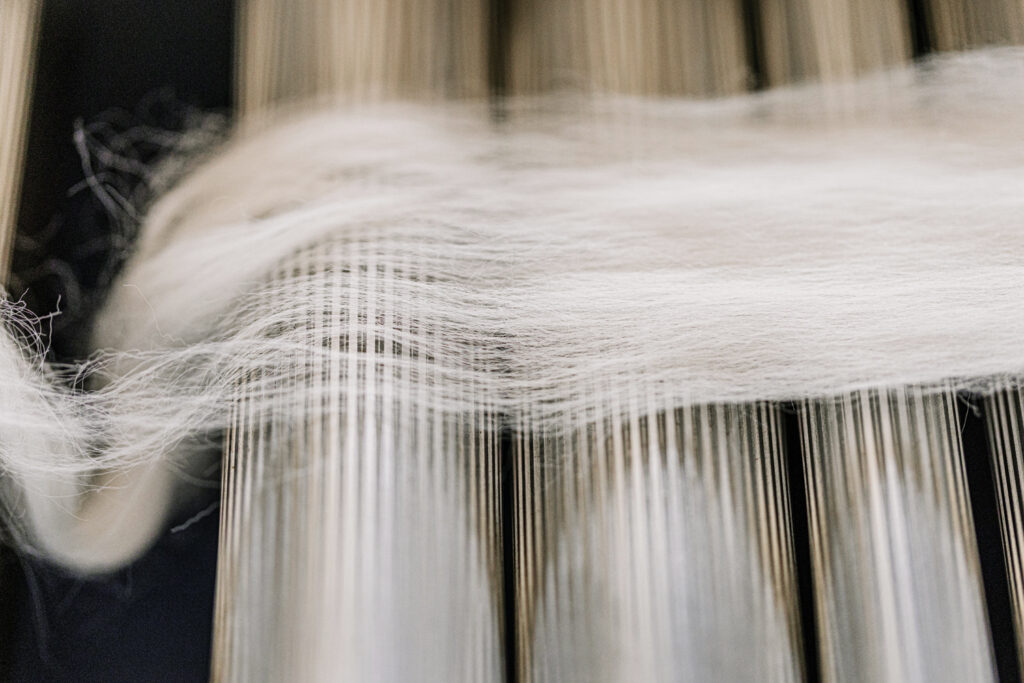
New York, N.Y.-based startup EVERBLOOM aims to capitalize on pre-consumer luxury-material scrap through chemistry and artificial intelligence (AI)—turning wool, cashmere and down into pellets that can be melt-spun and worked on the same machines as synthetics.
The company’s raw materials are keratin-rich textile waste material from mills and clothing manufacturers. This niche exists because of the textile regulations in Europe that ban companies from landfilling or burning their waste products and unsold goods.
EVERBLOOM’s process breaks down and purifies the material to the protein level then modifies it into a form that can be pelletized for industrial machinery. Additives are bio-based, without petrochemicals. The resulting biofiber, the company says, is softer than merino, lighter than cashmere and stronger than silk.

The technology has been under development for eight years by EVERBLOOM cofounders Michael Jaffe and Simardev Gulati, fiber scientist and CEO, respectively. Gulati has a history with textiles, including working for his family’s textile business.
“I come from a third-generation textile background,” Gulati says, “so I’ve grown up around the industry and its infrastructure. What stood out to me was the untapped potential of existing systems to regenerate a largely overlooked waste stream—protein-based materials like wool, cashmere and down.
“That insight became the foundation for the process,” he continues. “From there, AI came in as a way to accelerate development—helping us better understand, optimize and engineer the material more efficiently than traditional trial-and-error approaches.”

AI to help custom-engineer fiber properties
For the past two years, EVERBLOOM has been working on its proprietary Braid.AI system. This system integrates thermoplastic protein engineering with predictive modeling to forecast how discarded proteins behave under specific processing conditions, including temperature, moisture and molecular weight. With this data, Braid.AI can accurately predict a fiber’s softness, strength, texture and dyeability before it’s made. The company will be able to custom-engineer fibers based on desired characteristics and reduce what once took two months of lab testing to two weeks.
The company has partnerships with luxury mills in Italy that work with cashmere fiber on the as-yet-unnamed product, and it has raised $8 million in a funding round led by Hoxton Ventures. EVERBLOOM is working with clothing brands on trials while continuing to optimize the fiber and prepare for scale. It has a new partnership with North Carolina State University’s Wilson College of Textiles to produce pilot-scale batches to move its fibers from lab to manufacturing.
Gulati says that focusing first on luxury materials as a feedstock source “doesn’t limit scalability as much as it might seem. These materials generate significant volumes of waste across the supply chain, much of which is currently underutilized.
“Our approach is to start with premium inputs because they offer the best performance and consistency,” he adds, “but the underlying process itself isn’t inherently limited to ‘luxury’ volumes. Over time, scalability will come from expanding feedstock streams and improving sourcing and sorting. So while the first applications may sit in a more premium segment, the long-term potential is much broader.”
Check out cutting-edge research, projects and art in the Swatches section of Specialty Fabrics Review each month.