 TEXTILES.ORG





In the early years of development, smart textiles and e-textiles were commonly referred to as “smart materials and systems.” In the 1990s, early adopters saw attendant technologies as crucial for operating systems such as structural health monitoring of infrastructure or earthquake warning systems.
On one level, technology integration is making tremendous strides. But as the demand for remote monitoring grows, so does the importance of systems. The growth in artificial intelligence capabilities — and their anticipated potential — feeds into the broader capability of what added value systems can deliver in an increasingly physical/digital world.
The benefit of bringing together these different dimensions is particularly apparent in developments of smart-textile-sensing technology aimed at large-scale use. Techtextil 2026 in Frankfurt am Main, Germany, showcased several examples and approaches.
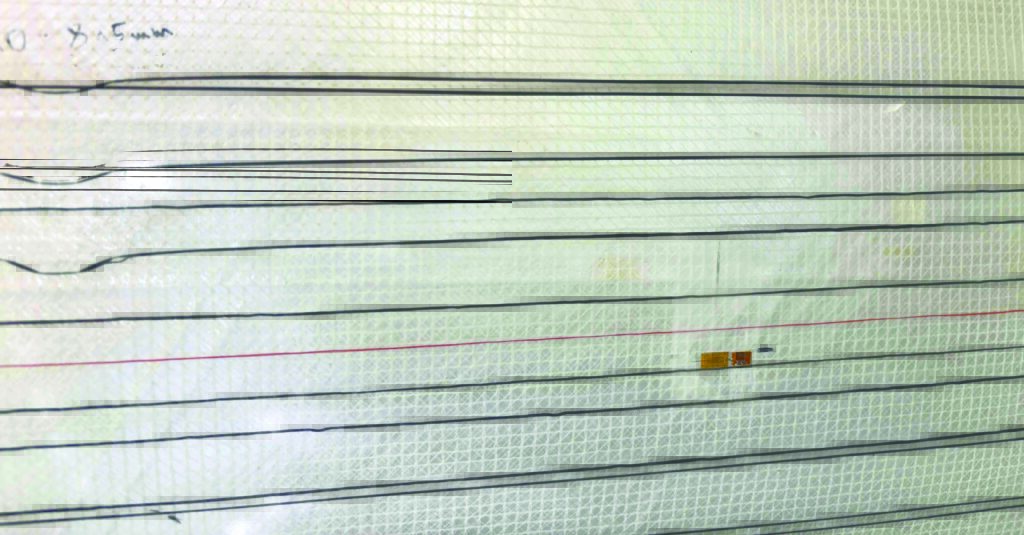
Barrier-free navigation
The Institute for Floor Systems at the RWTH Aachen e.V. originated in 1964 as the German Carpet Research Institute e.V., a partner for research, testing and certification. The institute has evolved over the years, associated under its current name as an affiliated institute of RWTH Aachen University in 2010. Core activities have been expanded to include the interior space, addressing walls, floors, ceiling systems and furnishings in buildings as well as vehicles.
ModuLeiT is a design guideline for floor indicators in indoor guidance systems for visually impaired individuals. It was selected to be showcased in Frankfurt this year as a research project funded by the German Federal Ministry for Economic Affairs and Energy. The intention was to address the limitations of current systems, such as the cost of installation in large buildings and poor aesthetics in outdoor applications.
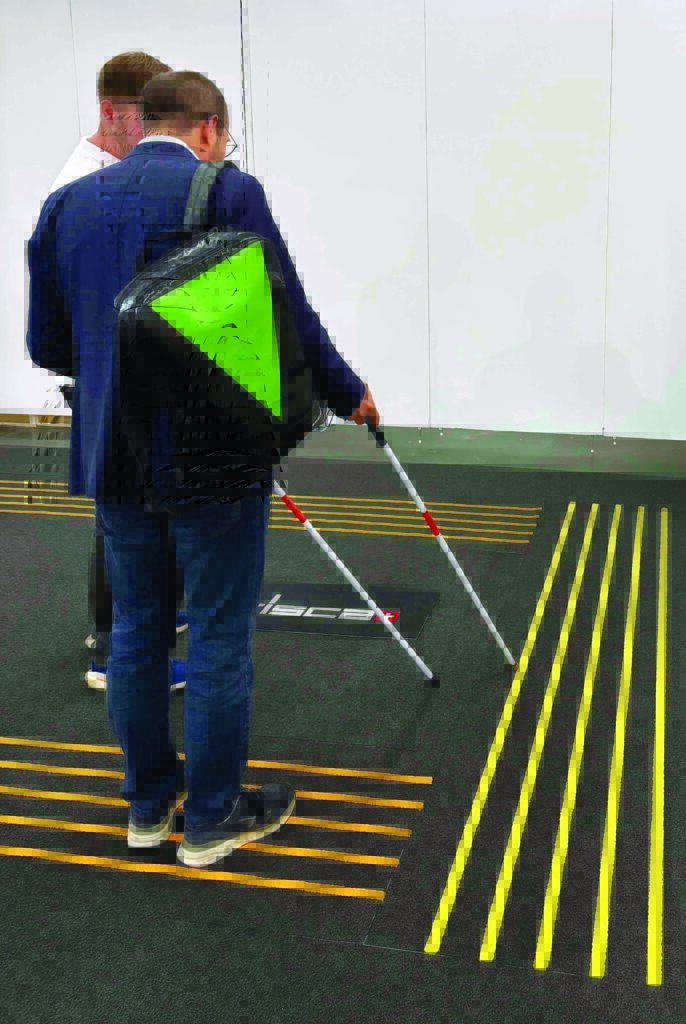
Tamara Thielman first came to the project as part of her master’s degree studies, going on to successfully complete the project as its manager. The design guidelines are provided for the development of textile floor coverings that have modular, haptic and visually perceptible floor indicators that integrate RFID technology and a navigation system. The system is linked to the Building Information Model to provide barrier-free navigation in real time.
Monitoring textile membranes
AI makes it possible to monitor textiles in remote or hard-to-access locations, such as in architectural membranes. These are subject to challenging weather conditions, from high winds to snow loads, over their lifetimes. Continuous monitoring of a membrane’s load and structural integrity over its lifetime can be challenging.
Addressing this, Hung Le Xuan from University of Technology Dresden, presented his work at the university’s booth and in a talk titled “AI-Assisted Monitoring of Textile Membranes.” His solution combines textile-integrated piezoresistive strain sensors with AI-assisted data evaluation to enable the detection of potential failures in real time so that necessary steps can be taken.
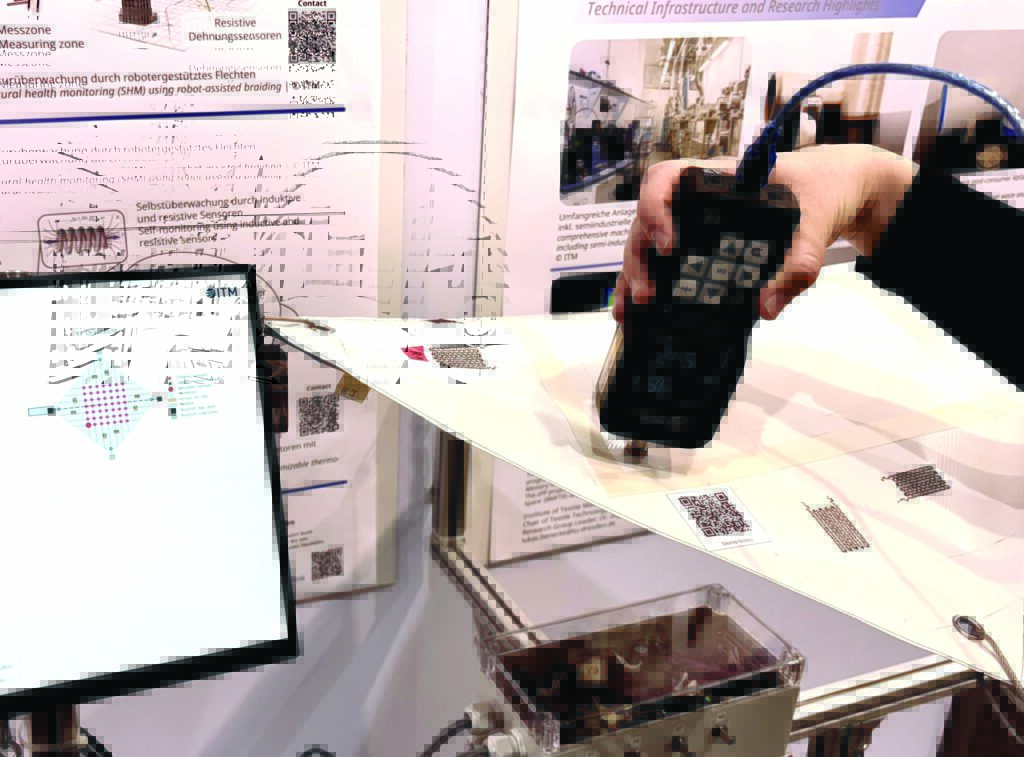
The AI is part of a system that includes yarn-based sensors, with AI used to predict position and force from data gathered by the sensors. The yarn can be incorporated during the weaving process, but it can also be applied afterward, using a tailored fiber placement technique that, as the name suggests, allows for precision placement.
This second process expands the possibility of retrofitting the technology, such as during a repair. It also allows the system to be used with an array of membrane types and geometries, using techniques to compensate for sensor drift, boundary effects and manufacturing tolerances. A regressive AI model is used to gather the load position and magnitude directly from the sensor signals, eliminating the need for the use of the finite element method of computation during the operation.
In his presentation, Le Xuan emphasized the scalability of the system being offered, pointing to additional advantages made possible by the AI-based evaluation process, such as the reduction in the number of sensors required without compromising accuracy.
Heat and pressure sensing
Heated textiles are much in demand in applications from apparel to car seats and buildings. The textile heating system from Kufner, a German global textile innovator, uses low energy to quickly achieve a temperature increase with a consistent heat distribution.
It can be produced in defined lengths and widths and combined with a range of carrier materials. Washable and lightweight, it can also be over-stitched. In a development with Austrian company Weitzer Woodsolutions, the heated textile is sandwiched between the wood panels for use in the walls and floors of buildings.
According to Swiss company Sefar AG, it offers “vertical integration from yarn engineering to finished products” in advanced filtration, mesh and yarn-based solutions. The company has developed the Sefar® PresSense Matrix textile pressure-sensing technology, using a woven force-sensing resistor fabric array. The sensor component allows the freedom to integrate pressure sensing into the product architecture with a thin, flexible and shapeable sensor.
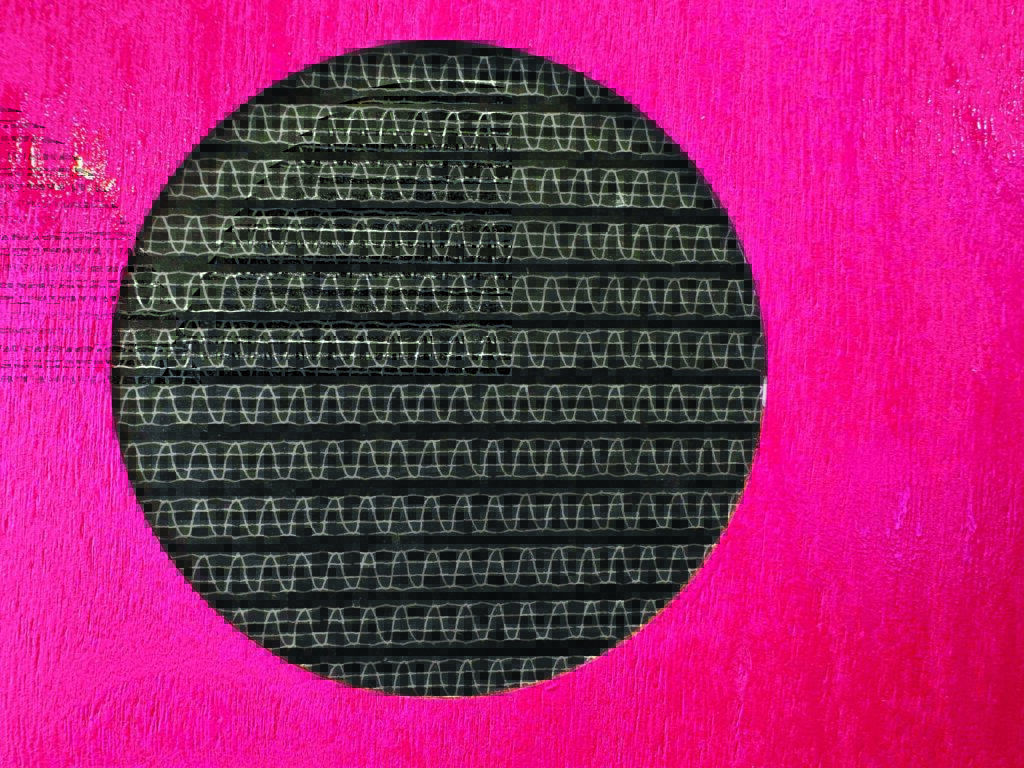
The benefit of the integration is that it allows for pressure detection, quantification and location mapping in a single-layer material. While pre-integrated connectors can reduce integration complexity and speed up development time, a complete sensing system that includes fabric, connectors, electronics and software enables immediate data acquisition and visualization to accelerate product development and speed to market launch.
The company can work with clients during the development process, helping to define technical requirements suited to final system integration. Its versatility, breathability and washability mean that it is well-suited for applications such as mattresses used to monitor and prevent pressure ulcers, wheelchairs to support the optimization of patient posture, and for rehabilitation therapy mats to enhance balance and posture.
Marie O’Mahony, Ph.D., is an academic at the University of Southampton in the U.K. She is also an industry consultant and the author of several books on advanced and smart textiles.
SIDEBAR: Shape-shifting aircraft wings
German engineers have introduced prototype morphing wings for aircraft that can change their shape mid-flight. Created by the German Aerospace Center (DLR), the project, aptly named morphAIR, aims to make aircraft more efficient and easier to control.
“The morphing wing can change its shape during flight, allowing it to adapt optimally to different flight conditions,” says project leader Martin Radestock from the DLR Institute of Lightweight Systems.
The wings are made entirely of fiber-reinforced composites, featuring a “shape-shifting” trailing edge section. This feature is enabled by the Hyperelastic Trailing Edge Morphing system, a DLR-developed technology that allows the wing to deform seamlessly, without steps.
“The continuous shape reduces profile drag. In addition, lift, induced drag and aircraft control can all be influenced in a targeted manner — a major advantage for aerodynamics and flight mechanics,” Radestock says.
DLR engineers developed an artificial intelligence-assisted flight control system designed to make full use of the morphing wing’s unique movement capabilities. During flight, the adaptive algorithm continuously monitors the aircraft’s actual behavior and compares it against a trained model.
When deviations are detected, whether from turbulence, damage or a failing actuator, the system redistributes commands across the wing’s many actuators in real time, maintaining stable flight. The algorithm was also trained on deliberate failure scenarios, teaching it to recognize and compensate for faults.
While these wings won’t be coming to commercial aircraft anytime soon, they’re a significant development for unmanned aircraft. As a next step, DLR plans to demonstrate scalability with a test flight using a Proteus aircraft with a total mass of 70 kilograms (154 pounds).
— Janet Preus
Janet Preus is senior editor of Textile Technology Source and a contributor to Specialty Fabrics Review. She can be reached at janet.preus@textiles.org.