 TEXTILES.ORG




So much goes into running a successful business decade upon decade, let alone for multiple generations — or even more than a century. This month, Specialty Fabrics Review profiles four of Advanced Textiles Association’s (ATA’s) legacy companies, including two of the 14 businesses that established the National Tent & Awning Association in 1912, ATA’s original moniker.
All of these companies have been around since the 1800s. But whether they’re making the same products as in the past or have pivoted from their origins, common themes regarding their staying power include monitoring industry trends, adapting to change, making quality products and exceeding customer needs.
Laacke & Joys Co. LLC
Since 1844, ATA founding member in 1912
Growing through changes
“The history of the company is something that we’re really proud of,” says Greg Mather, the president of Laacke & Joys Co. LLC, Brookfield, Wis.
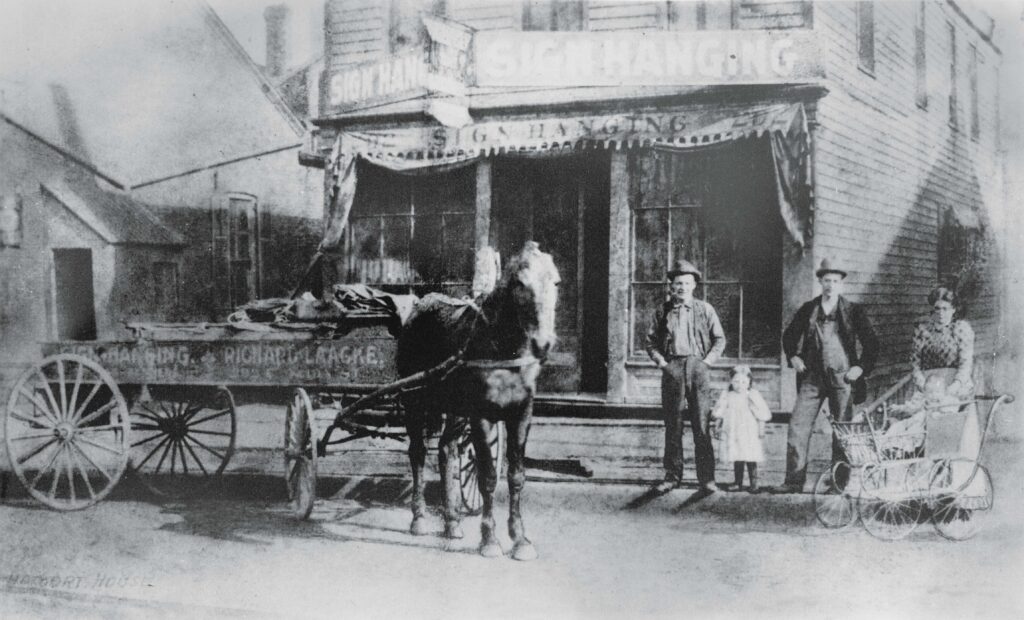
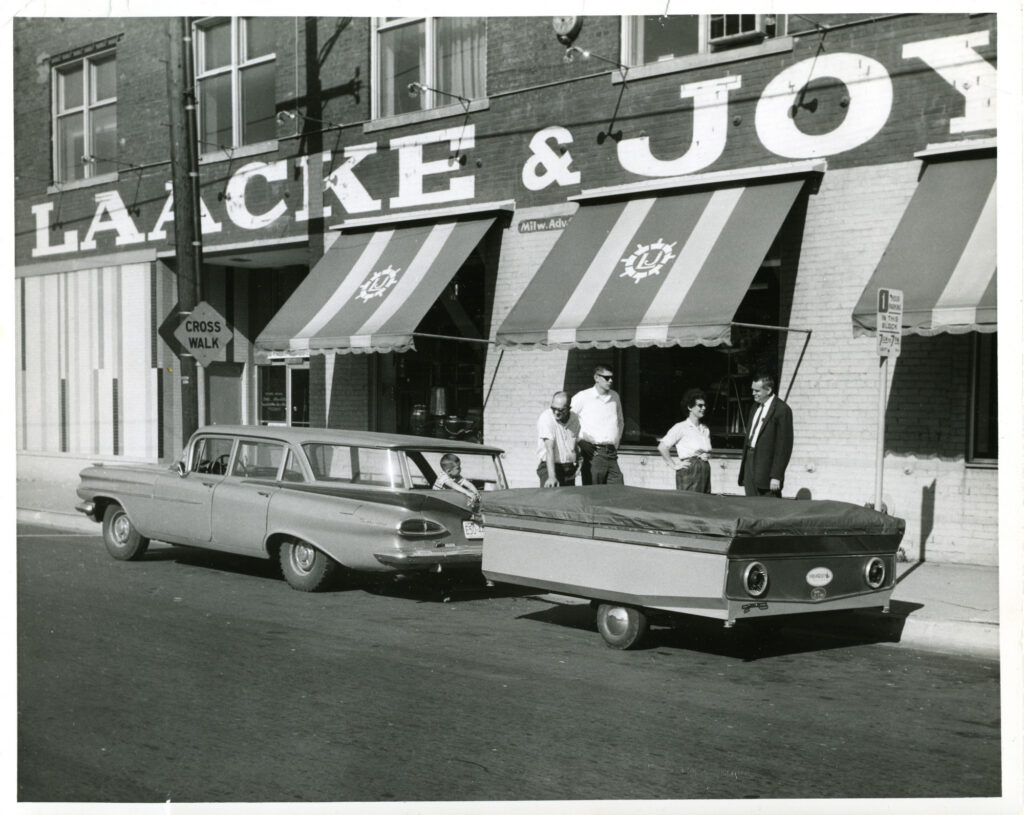
Its origins date to 1844, before Wisconsin was even a state, when Greenleaf D. Norris opened a ship chandlery on the Milwaukee River, providing goods and services including canvas sail repair. Following a change in ownership in 1869, G.D. Norris & Co. became Joys Brothers Co. in 1885.
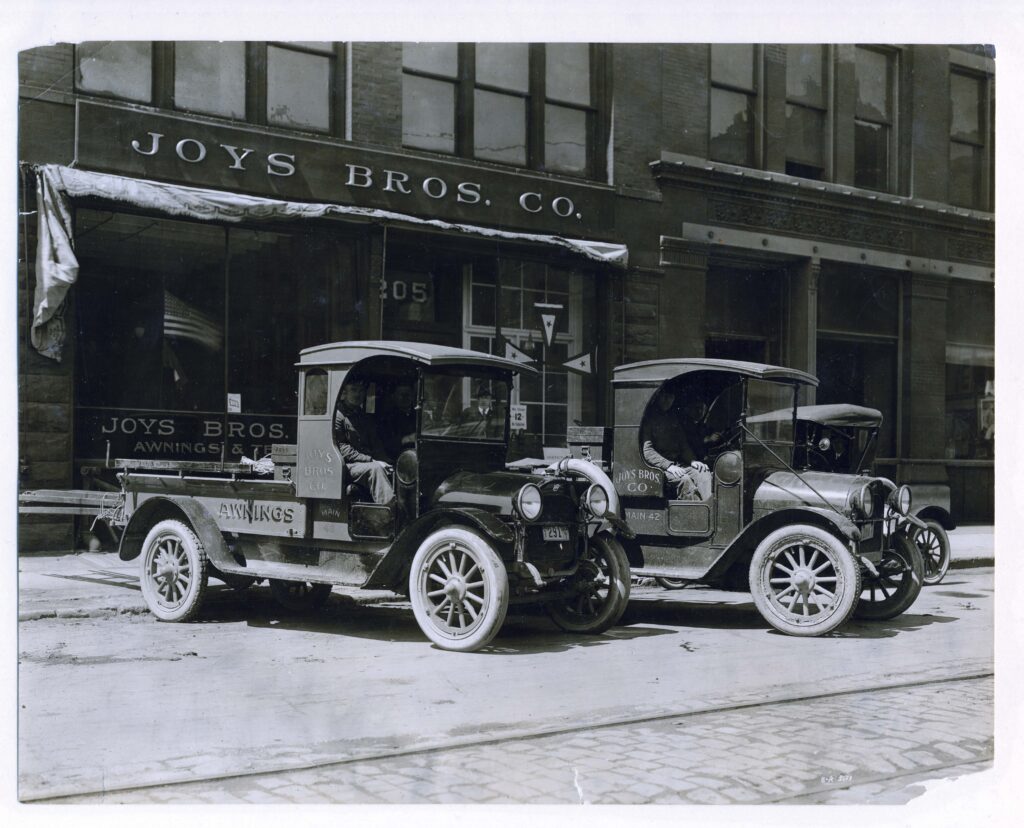
Around that same time, Richard T. Laacke opened up a sign and awning company in Milwaukee. It started making canvas products in the 1910s and helped found the National Tent & Awning Association in 1912.
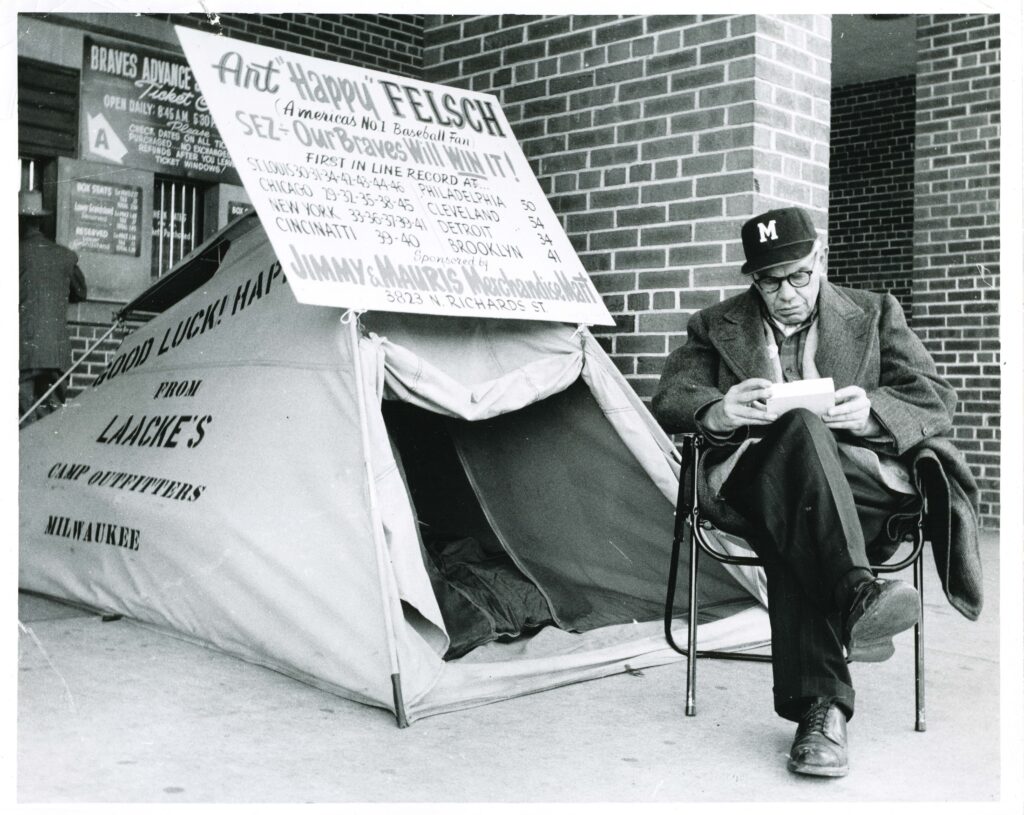
Laacke & Joys came into being in 1957 following a merger. Its next focus became putting products into retail outlets and opening a shop to sell tents and pop-up campers. “It evolved into a sporting goods store where there was ski in the winter, then patio in the summer,” Mather explains.
The next pivot was in the 1980s, when tapping into staff engineering expertise turned into OEM work. That shift to industrial design and manufacturing is reflected in the division LJ Design & Manufacturing. Today, the business works with companies to create products ranging from medical devices, equipment covers and protective gear to 24/7 office chairs, the latter via the Concept Seating division.
“There’s been changes of focus, but I think it’s always … how can we provide value to customers?” Mather says. “That’s gone from the military, awnings, canvas, to retail outlets, to now a huge focus on OEM manufacturers and using our engineering and industrial sewing expertise.”
With that last major change in direction to OEM work, the organization needed to scale up in business departments and knowledge base both. By approaching the challenge with the mindset of being its customers’ dependable partner, he says Laacke has been able to grow right along with them.
“It’s way more efficient to work with an OEM supplier than to try to do some of these products on [their] own,” he says. “We’re just seeing that over and over again.”
For all the changes in focus and manufacturing techniques over the decades, Mather says a key to longevity is a culture of respect for their people and operating with the company’s purpose in mind: “How can we leverage what we’re good at: designing, engineering and manufacturing sewn products to help our customers scale their business and better serve their customers? We are uniquely fortunate that we have such deep expertise in this specialized industry and have been able to hone those skills over our 180 years to grow with and be responsive to our customers’ needs.”
Hoigaard’s Custom Canvas & Awnings
Since 1895, ATA founding member in 1912
Concentrating on the core
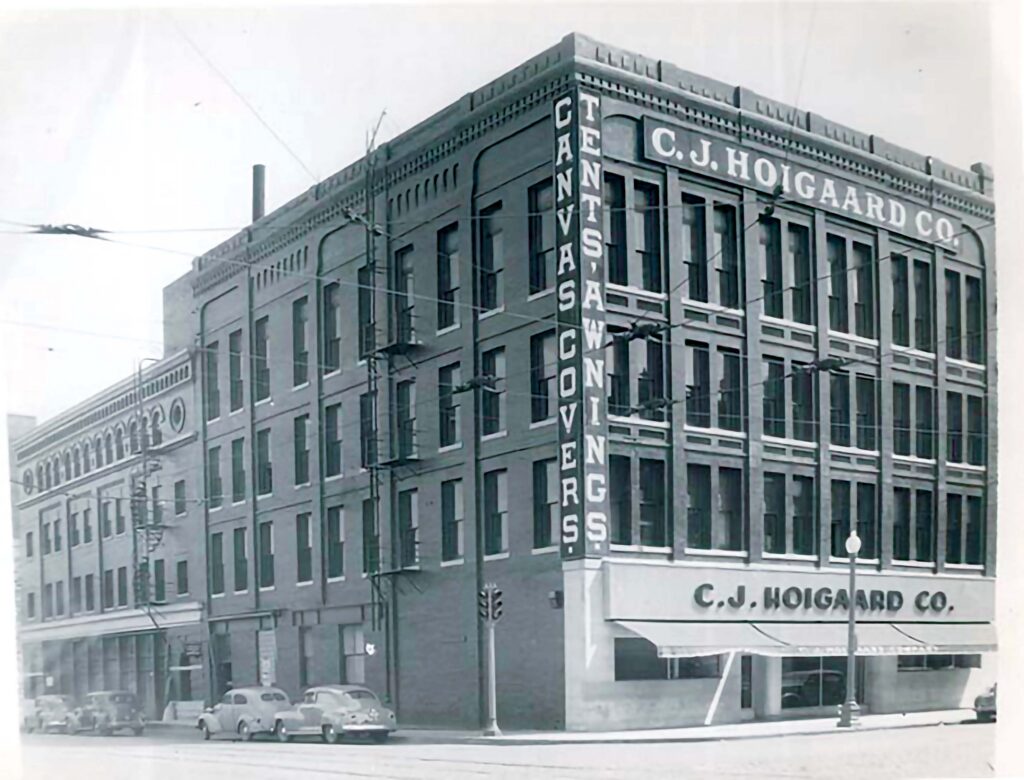
In 1912, representatives of 14 canvas and awning companies got together in Denver, Colo., to work together toward common industry goals. One of those companies was C.J. Hoigaard’s, already an established brand in the Minneapolis, Minn., area.
C.J. Hoigaard began selling canvas in 1895, creating custom tents, tarps and awnings that could function in the extreme cold. Products soon included items such as tents for the Alaskan gold rush, horse blankets, cow covers, fly nets and custom projects. The company soon branched out into awnings, shelters and military supplies during the World Wars and grew to make — and retail — sporting goods, outdoor umbrellas, patio furniture and ski equipment.
Starting in 2012, the company narrowed its focus to its core awning business, selling off several divisions, including the company’s retail store specializing in outdoor sports equipment and apparel. (The new owners honored that longtime legacy by keeping the store’s name.) That remaining core business, Hoigaard’s Custom Canvas & Awnings, concentrates on creating and servicing awnings and shade structures and making custom products, from fire-hose bags to stretcher covers.


“Since the original origins of Hoigaard’s, there’s only been two different ownerships prior to the current owner, as far as the awning portion goes,” notes Angela Gaffke, Hoigaard’s marketing manager. That consistency has helped the company maintain its values over the decades — namely, as Gaffke says, having skilled employees “providing quality and timeliness and service.”
To bring those values into the 21st century, Hoigaard’s has embraced new methods for manufacturing the company’s classic products, like the Sunbrella® Graphics System machine and a Triad welder for heat-sealing fabrics.
At the same time, Hoigaard’s maintains a stock of parts for older spear-style and rope-hoist awnings as well as the means to maintain them. “A lot of those older homes have those old-style awnings … so having some of the old spears and different awnings from so long ago has been good for us because we’re able to service them,” Gaffke says.
Sustaining a business does require some diversification in its product lines, even if they’re concentrated around a core business. In addition to fabric awnings, the company also sells metal awnings, porch curtains and tensioned shade sails. “We’re able to diversify with the staff we have and our crew,” she says. “They’re willing to continue to grow the company.”
The company has seen trends come and go over the years, such as backlit awnings, which some cities no longer allow. “You have to be able to adjust with the changes in the industry,” she advises.
Stimpson®
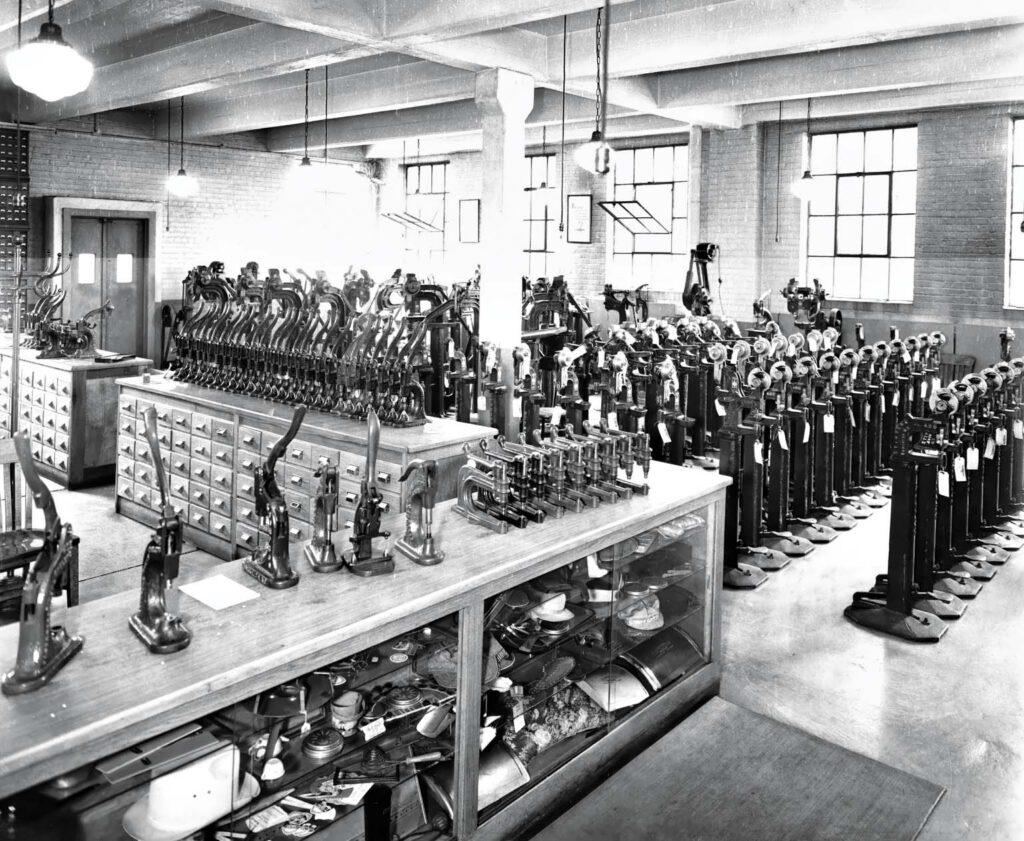
Since 1852, ATA member since 1995
Diversifying markets is key
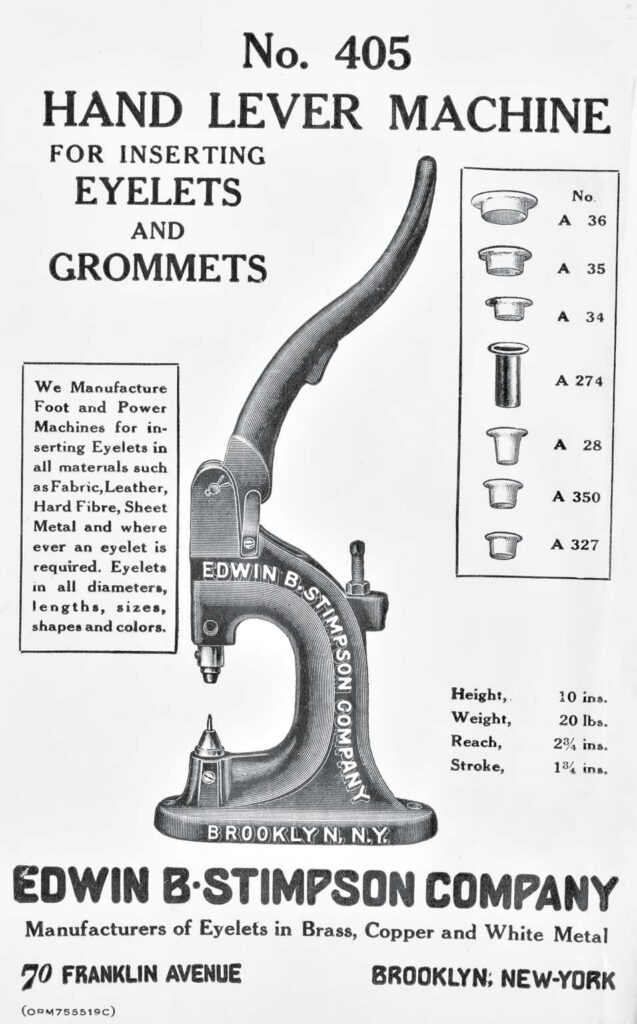
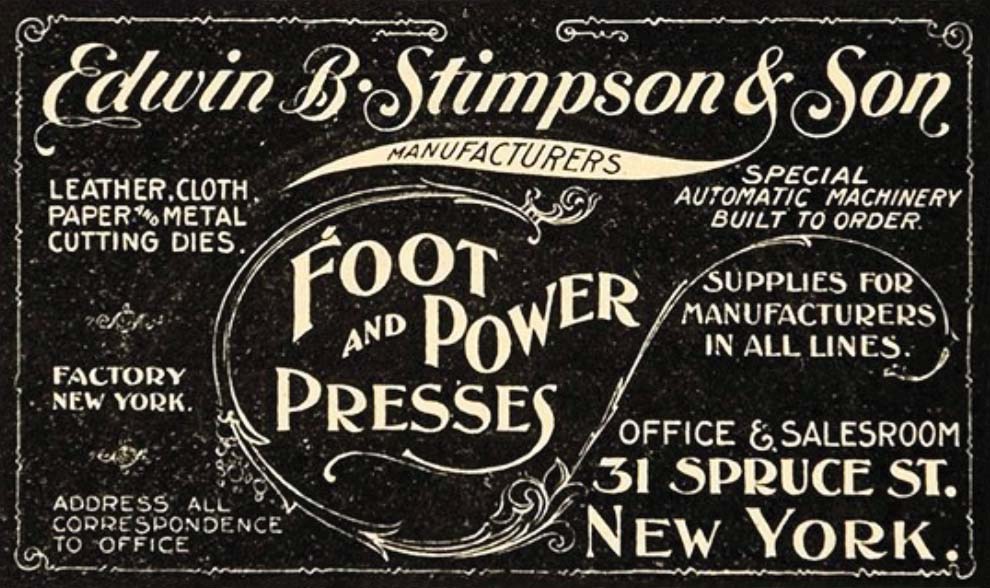
Edwin B. Stimpson established the company that bears his name in Lower Manhattan, N.Y., in 1852, near what would eventually be the Brooklyn Bridge. Eyelets, grommets and washers — along with the attaching machinery to set them — were the core of that original business. They remain a constant today, although the metals used have changed some and the markets and product lines have broadened. Edwin Stimpson Jr. patented grommet-setting machines in the late 1880s.
In 1961, Stimpson opened its second facility at the request of a major customer. “They didn’t feel comfortable with our only having one manufacturing facility … in case something were to happen,” explains Cory Rau, the company’s current president and great-grandson of Henry Rau, a former vice president of the company and who purchased it from the Stimpson family in 1930.
They didn’t look anywhere near their neighborhood, though. “My grandfather and his twin brother really liked to fish,” Rau says. “So they decided in the mid-50s to build a facility in Pompano Beach [Fla.],” where big-game fish were plentiful.
Rau started working at the company in shipping during college, then customer service, purchasing and IT. He credits his time in charge of nonconformance memos with helping him understand customer needs and what can go wrong with a part. His time in IT helped him learn about the company itself on a deep level.
“If you’re good at IT, you learn what the people out there need,” he says. “You have to work together with them, understand what their job is and how they do it.” That’s analogous to working with customers.
Stimpson has been well-positioned to weather changes because of market diversity, including electronics, aerospace, banners, fall protection, awnings, and marine and outdoor gear. “If one industry has a dip, another industry will take up the slack,” Rau says.
For the future, preserving institutional knowledge is a priority. “We’re building a silo of videos and technical documentation that AI will be able to interpret and give answers to real-world questions. … It’s a new way of handing down the institutional knowledge that you need,” he says.
Rau is proud to provide a career path for young people who prefer learning a trade to attending college. “Our message to them is that you can be successful here, and you can have a lot of upward mobility,” he says.
The company’s focus on quality and taking care of customers and employees are at the heart of Stimpson’s nearly 175 years. “I get excited about improving the environment here and just making it a place that people love to work,” he says. “That’s what gets me up in the morning more than anything else.”
The Sattler Group
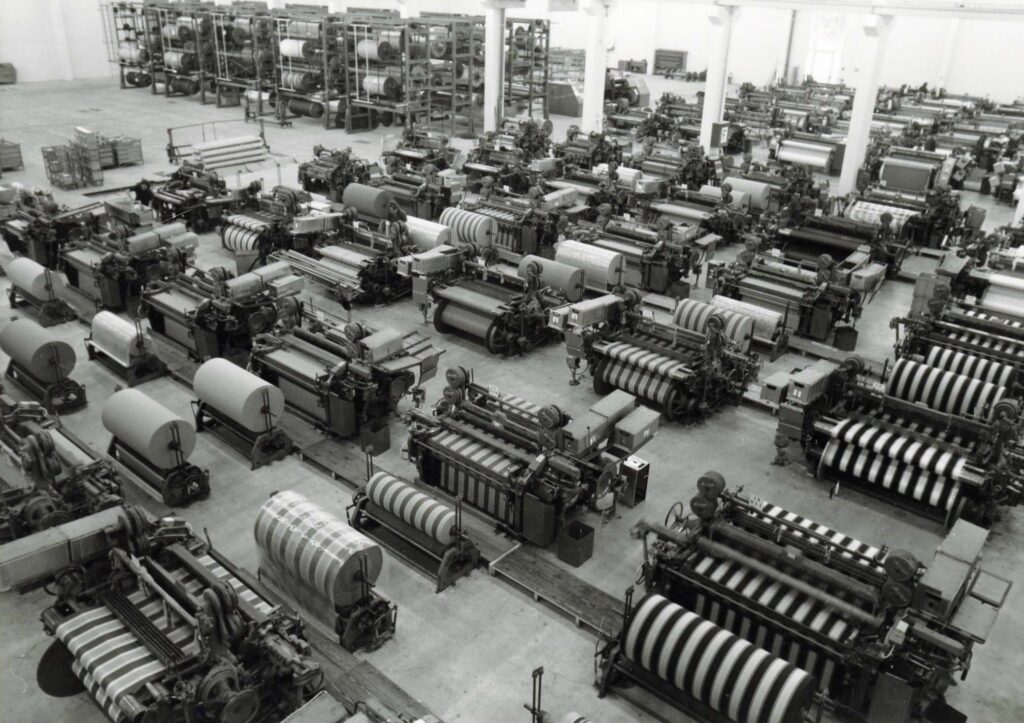
Since 1875, ATA member since 2006
Expanding internationally
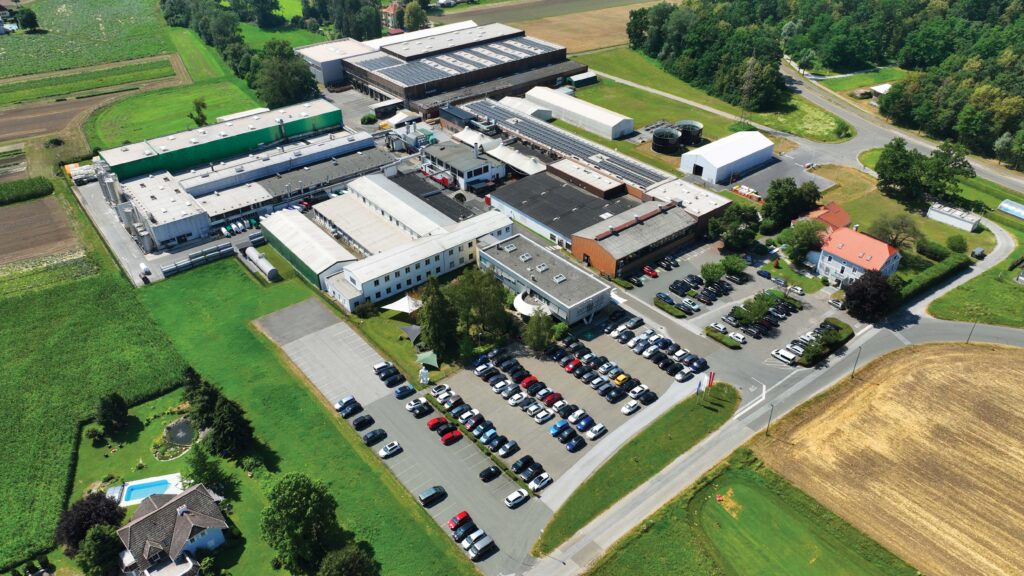
The Sattler Group, based in Gössendorf, Austria, is a true generational family business. August Sattler founded his company in 1875 in Graz, Austria, where it began producing tarpaulins. Today, it creates and manufactures specialty synthetic fabrics for home and industrial use, ranging from awnings and furniture coverings to membranes and truck covers. Current owner Alexander Tessmar-Pfohl, the founder’s great-great-grandson, credits the company’s nimbleness for its success: “to keep up with the changes and to renew ourselves, to a certain extent.”
In the early days, the company “was mainly focused on local demands,” says Tessmar-Pfohl. “The more the business grew, there was necessity to go into export markets.”
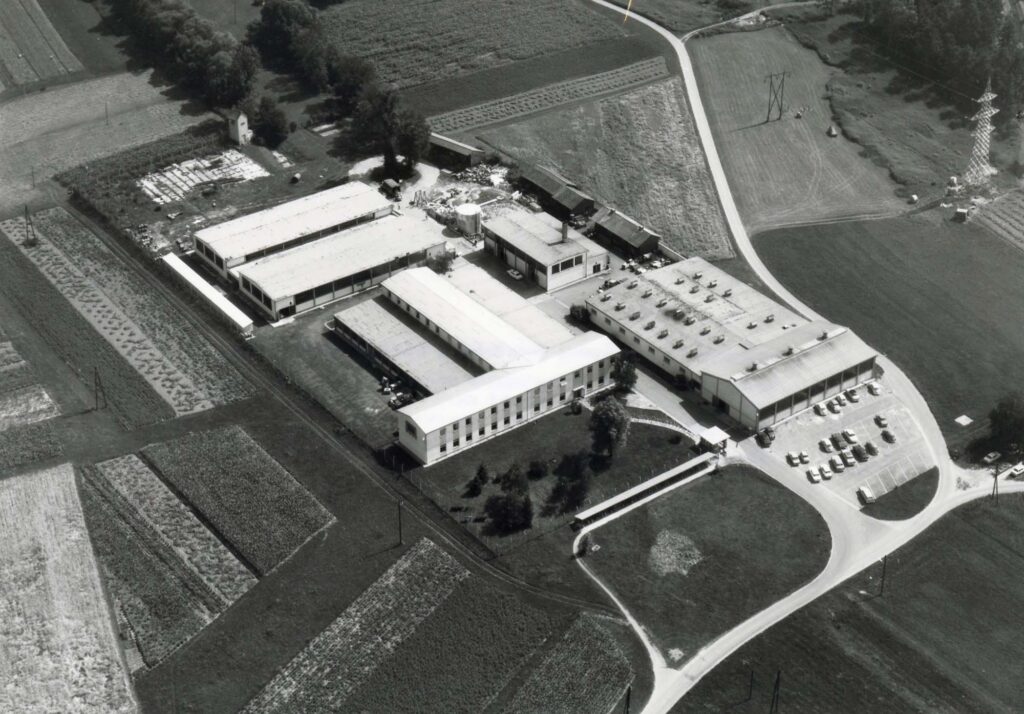
Sattler expanded into exports after World War II. When Austria joined the European Union in 1995, that opened an even wider audience to the company. The establishment of the euro helped in doing business across borders, eliminating exchange rates, for one aspect.
As growth has happened over the decades, product lines have come and gone in reaction to changes in the markets. For example, in the 1970s, Sattler produced textile wall coverings to meet a sudden demand. “This was just a short height during the ’70s. It disappeared as quick as it appeared,” says Tessmar-Pfohl. “This was a good experience as an organization — to let go when you see the market is just disappearing.”
Change is a constant, whether that’s in markets or in improved technology to make the products. What has remained the same throughout the long history of the company is its foundation, “the basic values of the family” and the staff, says Tessmar-Pfohl. “We know that only as a team, we are able to succeed. And I believe this is still [a] very important characteristic of our organization.”
He continues, “Running a business is always about people.” Whether customers or suppliers, “it’s still the personal relationships that matter. … Trust is a currency that’s very hard to build, but it’s spent or lost very quickly.”
He said he appreciates the so-called American way of competitors coming together around common ground in the industry, such as through opportunities to network via ATA.
While he focuses on his family’s business, Tessmar-Pfohl keeps an eye open to the rest of the world and the future. He’s particularly focused on sustainability. “We all see or notice … climate change,” he says. “We will never find the one big solution or button. … But it’s a continuous effort, and everyone needs to contribute to a solution.”
SIDEBAR: Industry involvement and connections help fuel long histories
Networking and staying on top of developments in markets and technologies play roles in companies’ longevity. ATA membership helps in key ways.
Understanding best practices: “We need our team to remain leaders on and on the cutting edge of the best practices and industry innovations. … Between the trade shows, education events, industry news and networking opportunities that [ATA] offers, our team has countless resources available to keep us at the top of our game.”
Greg Mather
Laacke & Joys Co. LLC
ATA founding member, 1912
Keeping in touch with colleagues at ATA events: “It’s good to get a pulse on the industry.”
Cory Rau
Stimpson®
ATA member since 1995
Coming together to solve industry-wide issues: “What I really like about the American way, if I may call it so, is that with all the competition among the several companies, there is still a common ground for the industry.”
Alexander Tessmar-Pfohl
The Sattler Group
ATA member since 2006
Finding out about market trends: “Having the ability to meet with various suppliers, that is very beneficial, because they’re the ones that are providing the new technologies.”
Angela Gaffke
Hoigaard’s Custom Canvas & Awnings
ATA founding member, 1912
Rose Auerbach is a writer and editor based in Los Angeles, Calif.
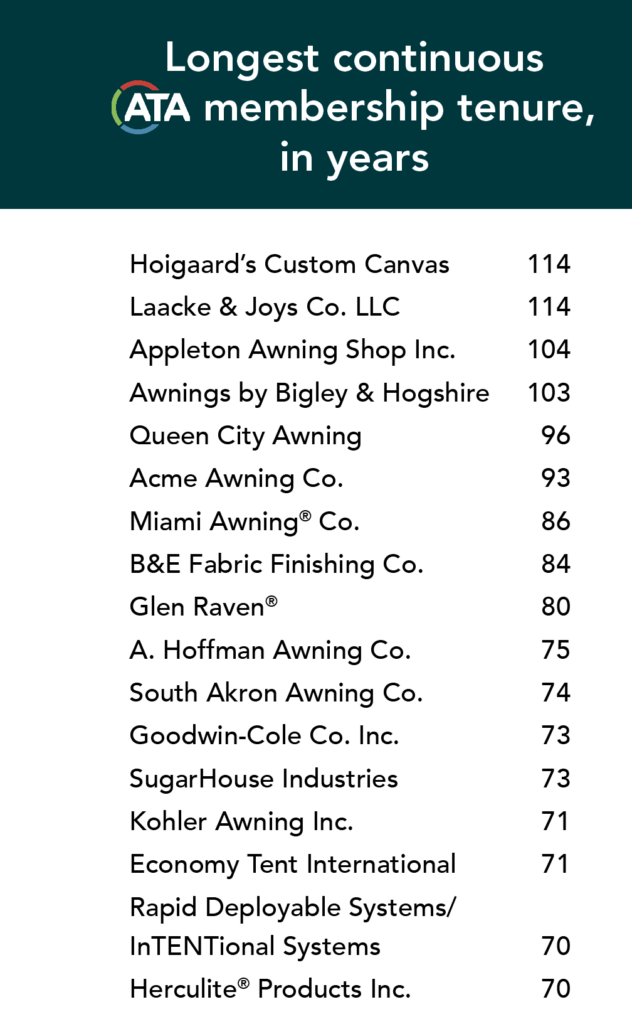
all companies that were acquired by others.