 TEXTILES.ORG




As workforce gaps widen and fabric sourcing and development grow more complex, textile companies are partnering with academic institutions to shape solutions. Integrating research, resources and education, the most successful collaborations are based on shared goals and a commitment to moving the industry forward.
“The critical question to ask is ‘How can we work together?’ not ‘What can I do for you?’ or ‘What can you do for me?’ It’s a small but important distinction,” says Karl Aspelund, Ph.D., associate professor of textiles, fashion merchandising and design at the University of Rhode Island (URI).
Starting local to scale
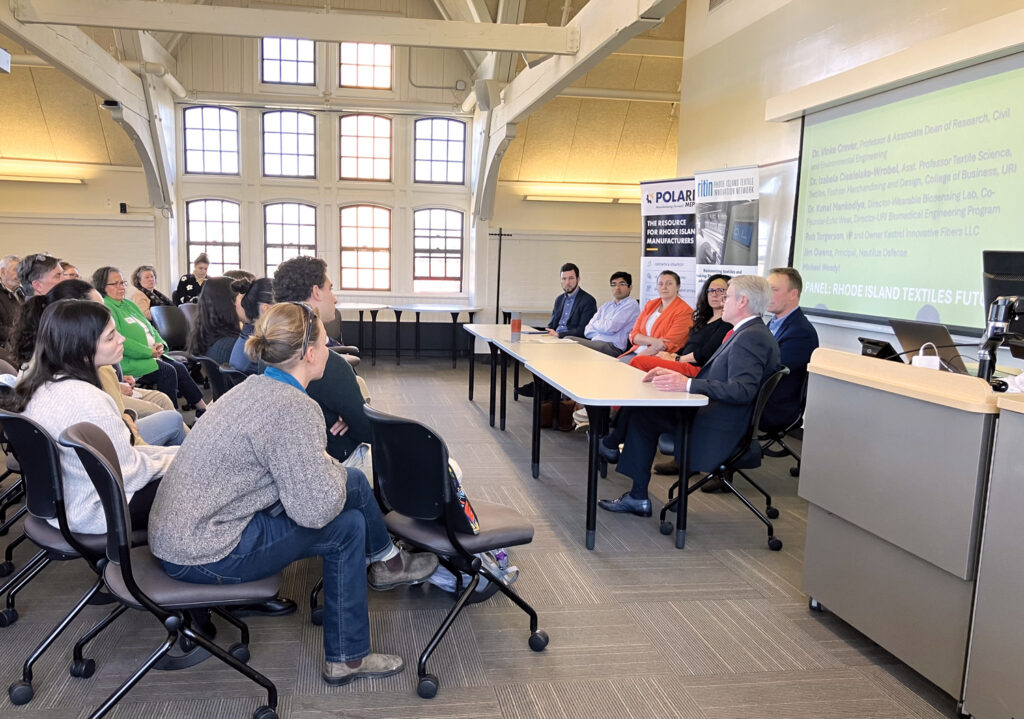
URI is a founding member of the Future Textiles Council, which grew from a student-led idea to regularly bring together companies, students and individuals dedicated to advancing the local textile industry. To create the council, the university partnered with the Rhode Island Textile Innovation Network, an affiliation of textile manufacturers focused on workforce training and opportunities for innovation and business development through partnerships between textile manufacturers, universities and government.
The idea emerged from a Future Textiles Forum in April 2024, where URI honors students presented research on the circular economy of textiles in Rhode Island to 24 local textile industrialists.
“As a land-grant institution, it is written into our charter to be supportive of the local industry,” Aspelund says. “After that meeting, we all realized we had similar goals and challenges and could solve them better together. That alone is a huge achievement.”
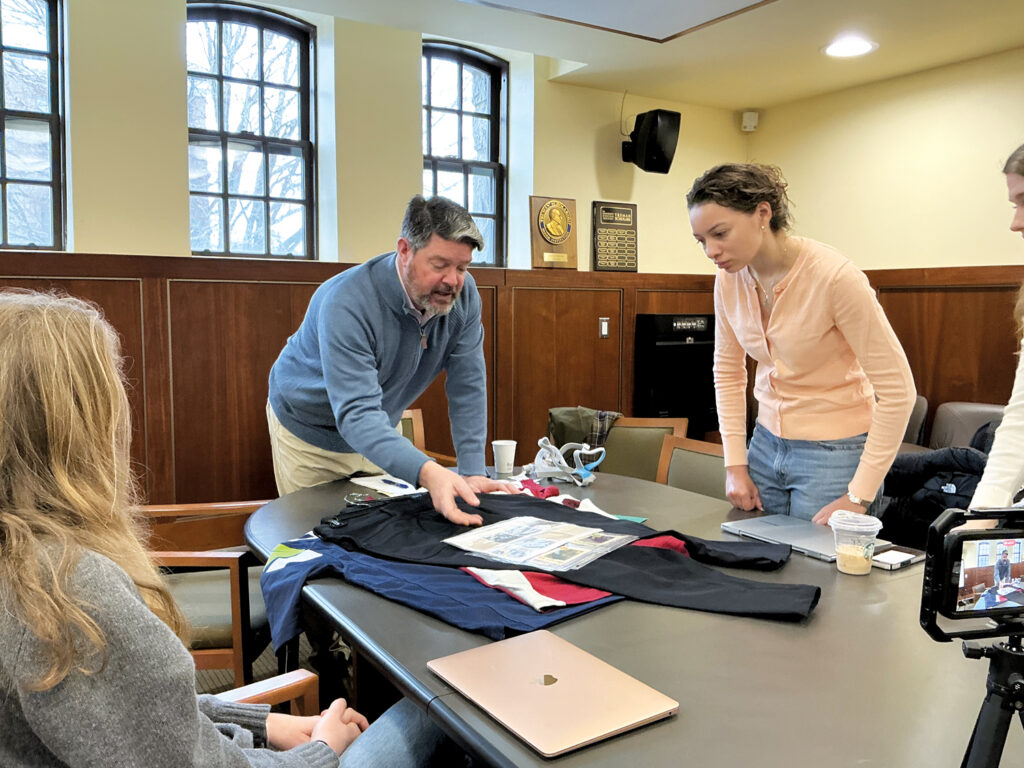
Now, with support from Advanced Functional Fabrics of America, they are creating educational materials grounded in real-world insights from industry leaders. Students in Aspelund’s independent study program are recording discussions with textile manufacturers, owners and CEOs to build online certificate courses. The content spans topics from the companies’ sourcing and production to marketing and is designed for students pursuing textile degrees as well as those looking to build foundational knowledge before entering the industry without a degree.
Three council meetings have followed the initial gathering, with attendees expanding through the Narragansett Bay region to include Massachusetts and Connecticut.
Aspelund also shares insights from the collaboration at conferences along the East Coast, highlighting how locally developed models can be adapted in different regions.
“As global business models start to look shaky, local manufacturing and circularity are going to play a more critical part in the industry,” Aspelund says. “The connection between schools and other entities is central to this effort, which is why we will continue to focus on community building in the coming years.”
Emphasis on local collaboration also shapes Aspelund’s thinking on future possibilities. One model he’d like to re-create comes from Greece, where fisheries collect and pelletize ocean plastics, treating them as a marketable resource.
“We could do that here; the technology already exists,” he says. “What’s needed is a shared mindset around local reuse, recycling and manufacturing practices. If we were to put a program like that into place, other regions could adapt the model to fit their own needs. The possibilities become endless.”
Breaking down barriers
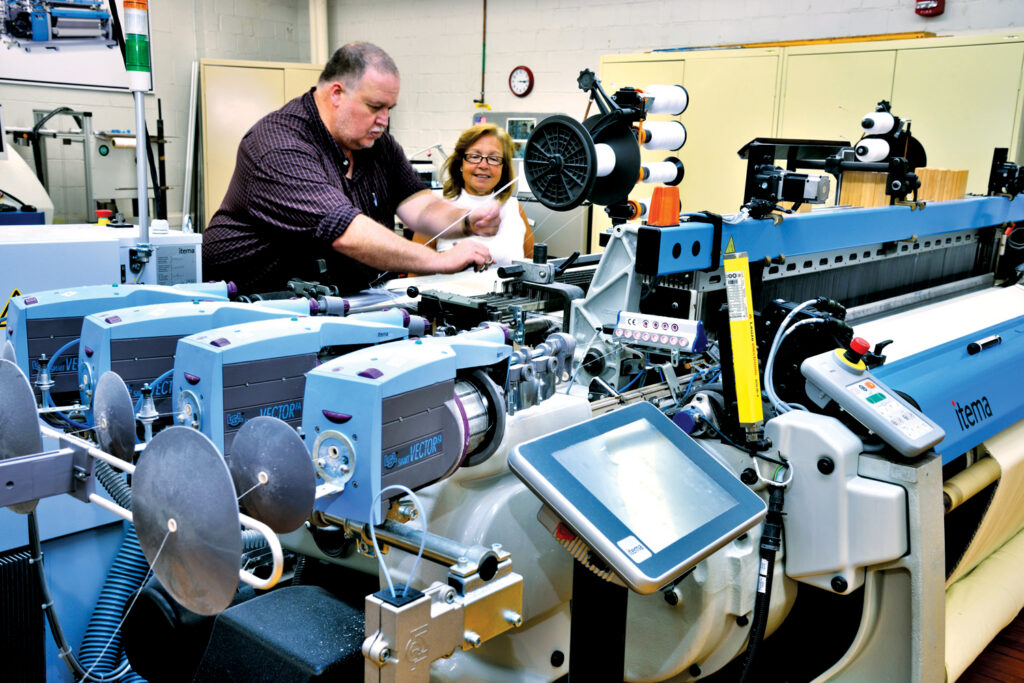
When it comes to bringing ideas to fruition, the Fiber Innovation Center at Gaston College’s Textile Technology Center has it down to a science.
“We serve as the critical success factor between research and commercialization,” says Jasmine Cox-Wade, executive director of
the Textile Technology Center and chair of Gaston’s textile technology degree program.
Funded by the state, surrounding counties and local and federal grants, the Belmont, N.C.-based center offers training, product development and research opportunities in fiber solutions for students, entrepreneurs and industry leaders at any level, of
any size, across the country.

“Commodity manufacturing has moved overseas and in other areas throughout the world, but textile innovation and the development of emerging technologies still happens here in the United States. For that innovation to make an impact quickly, you need a local resource like the Textile Technology Center to help overcome the barriers to implementing new technologies,” Cox-Wade says. “Customers have told us that what once took three years and coordination with multiple locations to develop a single product was cut in half by working with us.”
The center operates on a fee-for-service model, with a team of 25 staff members committed to testing and development for an average of 150 customers a year. “These are not your traditional staff members focused on theory and research,” Cox-Wade notes. “These are experts who bring hands-on experience from textile manufacturing. Some are in a second career, while others spent years on the floor and want to apply that knowledge in a new context.”
While students are not directly involved in product development, the center is also focused on helping customers navigate the shifting workforce demographic in the textile industry. With support from its board, the state and North Carolina State University, the college revived its previously inactive two-year degree program in 2021, giving more students the opportunity to fill the technical staffing gaps many companies face.
“We are leveraging our university partners and the fact that we are at a community college with amazing programs like applied engineering and mechatronics to create awesome pathways that combine new technologies with textiles to train a new workforce,” Cox-Wade says.
Collaborating with credibility
North Carolina State’s Textile Protection and Comfort Center (TPACC) takes a more targeted approach to workforce training, equipping students to support companies that serve frontline workers, including firefighters, first responders and military personnel.
It has also taken on a new name through 2030, thanks to a $1.5 million donation from the Milliken & Company Charitable Foundation in 2025: the Milliken Textile Protection and Comfort Center. This investment is helping to advance TPACC’s research and development for high-performance protective wear and fund new Milliken Fellowships, increasing stipends for graduate students.
“We appreciate this gift as a formal recognition of our leadership,” says Bryan Ormond, Ph.D., director of TPACC and associate professor of the textile engineering, chemistry and science department at North Carolina State’s Wilson College of Textiles. “We’re almost entirely self-supported based off the work we do, whether that’s research grants or testing services for the industry. So this type of funding relationship is incredibly important.”
Milliken’s relationship with the Wilson College of Textiles began in 2009 with scholarship funding. Ormond says the benefit of a long-term relationship like this is a foundation of trust that makes it possible to take risks and pursue new opportunities, such as research and testing on non-fluorinated moisture barriers for firefighters and improving respiration protection for wildland firefighters, which students are helping to lead.
Ormond points out that working closely with a single company can create a perception of bias. “Ultimately, we’re an independent research center and academic institution. That’s essential to our credibility because we don’t have specific deliverables for one company or another,” he explains. “At the same time, our relationships with textile companies as well as our end users are the reason we can help them both identify and solve gaps. Our goal is to improve the entire industry—not just for its own sake but for those on the front line—while fostering new talent along the way.”
Holly Eamon is a business writer and editor based in Minneapolis, Minn.
SIDEBAR: Starting with a conversation
Successful collaborations often start with a conversation, where shared values and mutual respect can reveal new opportunities.
“Building relationships through ATA [Advanced Textiles Association] committees and events helps me stay connected to the pulse of the industry,” says Jasmine Cox-Wade, executive director of the Textile Technology Center at Gaston College. “You need to start by ensuring your goals are relevant to industry needs.”
That connection can also take a more direct form. For those seeking research support, Karl Aspelund, Ph.D., associate professor of textiles, fashion merchandising and design at the University of Rhode Island, suggests reaching out to a college’s engineering, textile or business department to explore student-led projects.
“For a few thousand dollars, you can fund a student who will gain industry exposure and real-life experience. It’s a win-win-win.”