 TEXTILES.ORG




Rapid advances in high‑performance fibers and the growing need for multi‑hazard protection are reshaping the protective textiles market, yet the real test of these innovations lies in the field. A compelling case in point is new research on how ballistic protection interacts with firefighter turnout ensembles — the highly engineered personal protective equipment (PPE) firefighters rely on every day. Looking at technology on its own is no longer sufficient for determining the practical, real-world performance of PPE; understanding the combined effects of the technology and applications demands a system‑level perspective.
Single-threat protection
Traditionally, fire service PPE has been engineered around a single‑threat model emphasizing heat and flame resistance. The outcome has been sophisticated, multilayer turnout suits that shield the body from extreme convective and radiant heat. However, this strength introduces a chronic trade-off: These garments can trap metabolic heat and moisture, elevating physiological problems and heat strain.
In parallel, ballistic protection has evolved to mitigate kinetic energy, using dense, rigid and, typically, non‑breathable aramid or ultra-high molecular weight polyethylene structures. Ballistic vests provide impact protection but also add considerable weight and can significantly hinder physical ergonomics and performance.
When firefighters wear both systems together, the interactions produce emergent effects that fabric- and component‑level testing do not inherently reveal. Hence, the importance of system‑level evaluation to understand the true trade-offs for responder safety and operational effectiveness.
Multi‑hazard responders
The need for integrated evaluation stems from a profound change in the fire service mission. The traditional image of firefighters primarily battling blazes no longer fully reflects current firefighter operations.
The most recent U.S. Fire Department Profile report indicates that 63% of departments — and nearly 97% of those serving populations over 100,000 — provide emergency medical services (EMS) for their communities. Surprisingly, only around 4% of emergency calls involve an active fire. Instead, roughly 64% of responses are medical, hazmat or other non‑fire incidents, with an increasing number occurring in volatile environments involving civil unrest.
In response, departments have begun purchasing and issuing ballistic vests as routine PPE. The push toward multi‑hazard readiness requires responders to perform tasks that strain the thermal and physical limits of traditional gear.
The TPACC research approach
Although fire departments have rapidly adopted ballistic vests, those departments have received little guidance on when and how they should be used with turnout gear.
Existing standards offer conflicting directions; for instance, ASTM E3348‑25 recommends not wearing body armor with turnout gear. Yet it also states that if a person wears body armor, then it should be under the turnout gear to reduce melting hazards, since most armor carrier fabrics are not flame-resistant.
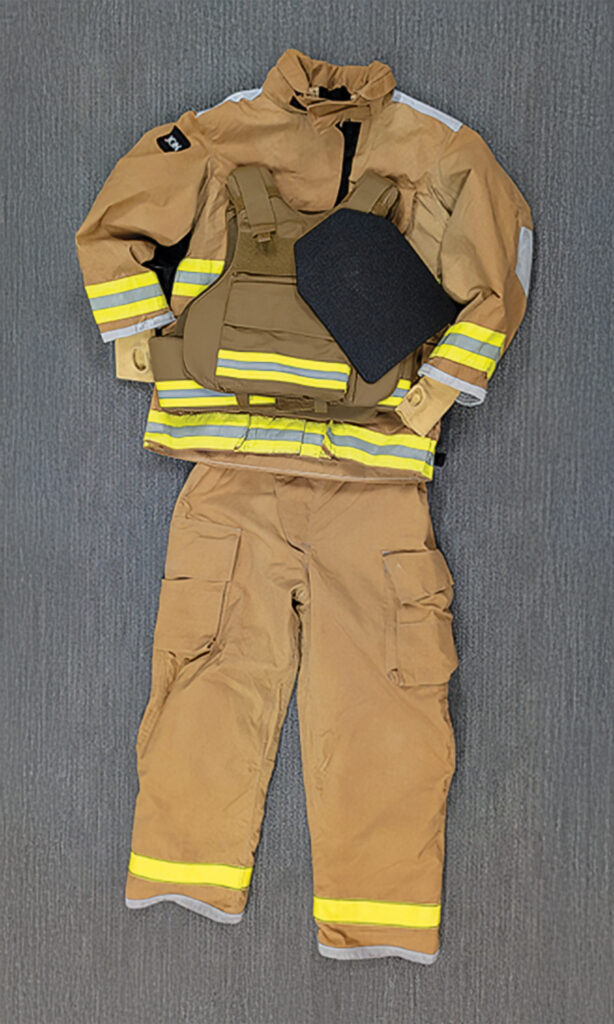
To satisfy the need for flame-resistant fabrics, the Milliken Textile Protection and Comfort Center (TPACC) at North Carolina State University, partially funded by a Department of Homeland Security Federal Emergency Management Agency Fire Prevention and Safety grant, launched a comprehensive system‑level research program. The project began with a review of current standards, along with a nationwide firefighter survey to document current practices and perceived trade-offs.
Three operational case studies followed, examining ballistic use in active‑shooter and civil‑unrest incidents. Technical evaluations integrated sweating thermal manikin testing, and TPACC conducted bench‑ and full‑scale fire protection experiments, including a live-fire, Molotov‑cocktail exercise.
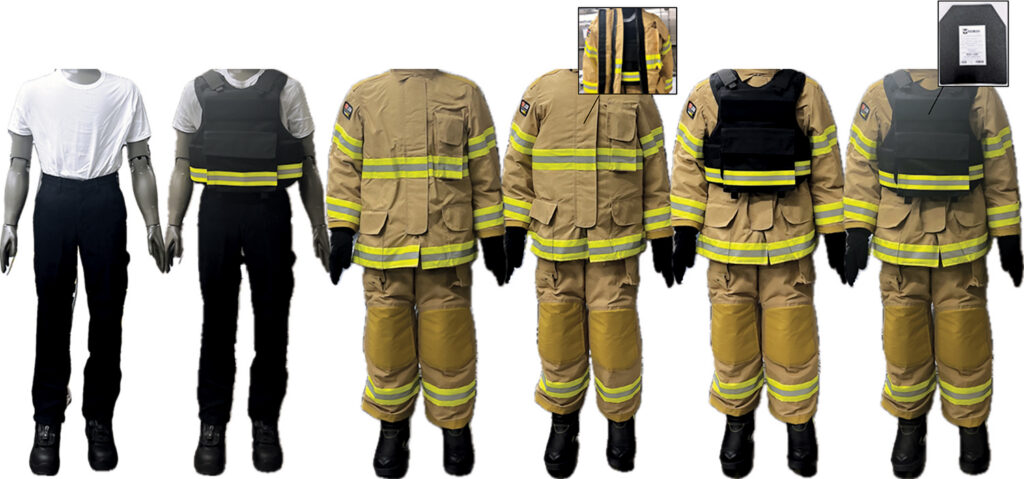
Central to this approach is the idea that protective‑ensemble performance is best understood when evaluated as a complete system. While material‑level data remains critical, it represents only one piece of the performance landscape. TPACC identified the trade-offs by examining six different ensemble wear configurations, from basic station wear to full turnout gear paired with both soft and hard armor.
System‑level evaluation
TPACC’s system‑level approach revealed trade-offs that are not apparent in isolated material or component-only testing. When a
vest is worn with a light station uniform, torso insulation nearly doubles and evaporative resistance increases almost threefold.
Adding a turnout suit over the same uniform raises both measures to nearly four times their baseline values. When the vest and turnout gear are worn together, the vest’s main effect is an increase in evaporative resistance. Once firefighters are equipped in the combined system, this effect significantly hinders the body’s ability to cool through sweat evaporation, further heightening heat‑stress risk.
These findings point toward a clear design priority for future ballistic and turnout systems: integrating ventilation pathways and improving evaporative efficiency while maintaining protective performance. The research also exposed pronounced ergonomic differences between covert (under‑the‑jacket) and overt (over‑the‑jacket) wear.
Overt configurations enabled better balance, quicker task performance and lower perceived exertion because the vest could move freely over the turnout coat. In contrast, covert configurations produced a “trapped and locked” effect, with the vest compressed beneath the bulky jacket, reducing mobility and shifting the wearer’s center of gravity. However, overt wearers must also contend with the fact that many ballistic carriers are constructed from non‑flame‑resistant materials.
Integrated understanding underscores a key opportunity for industry innovation: developing fire‑resistant ballistic carriers that maintain the ergonomic benefits of overt wear without compromising safety.
Female firefighters
A long‑standing gap in PPE design is the reliance on a male‑centric model. According to 2020 data provided by the National Fire Protection Association, women constitute nearly 10% of the U.S. fire service. So, a “one‑size‑fits‑all/most” model is increasingly unworkable. TPACC prioritized system evaluations, using manikins as well as male and female participants, to probe differences in fit, microclimate formation and ergonomic outcomes.
Results show that female responders encounter distinct trade-offs. Differences in chest curvature and torso breadth influence how garments and armor sit on the body, shaping the formation (and stability) of insulating air layers. In many configurations, the female manikin registered higher evaporative resistance because the standard gear failed to conform closely, trapping stagnant, humid air.
Importantly, thermophysiological modeling indicated that at similar work rates, female firefighters can experience greater thermal strain (higher core and skin temperatures) linked to lower average sweat rates and different surface‑area‑to‑mass ratios. Ergonomically, although female participants often outperformed males in balance tasks, they were disproportionately constrained by universal‑fit vests that did not reflect their body shapes.
The takeaway is that the performance implications of ballistic integration are not uniformly distributed across the fire service, reinforcing the need for different size ranges and distinct male/female shaping in future protective textile systems.
A trade-off guide
TPACC’s work shows that the benefits and nuances of integrated protection can be best realized when the risks and trade-offs are quantified at the system level. For fire chiefs training officers and frontline responders, this translates into an actionable “trade-off guide” for policy and procurement.
A central policy‑relevant finding is the establishment of a 15% impairment threshold: Ergonomic performance declines greater than 15% in mobility or task speed should be considered a significant operational risk. This benchmark is grounded in evidence that firefighters’ performance drops by approximately 2% for every kilogram (2.2 pounds) added to their ensembles. Together, these markers provide chiefs with concrete criteria for evaluating the net impact of new gear and wear strategies.
Risk‑based deployment also emerges clearly from the data. For missions without fire involvement (e.g., EMS calls in warm zones), pairing ballistic protection with station wear can provide necessary protection with substantially less thermal burden than full turnout gear. Conversely, any scenario with credible fire risk should default to covert wear (or to overt systems with fire‑resistant carriers) to minimize ignition and flame‑propagation hazards. This is especially relevant given the demonstrated risks of simple incendiary devices.
The path forward
Ultimately, fabric swatches, isolated resistance values or single‑threat standards can’t fully capture the complexity of wearing ballistics with firefighter turnout gear. A system‑level methodology uncovers that the “best” configuration is mission‑dependent: Overt wear may be justified to maximize mobility for medical response in warm zones, while covert (or overt with flame‑resistant carriers) is essential wherever fire exposure is plausible.
For manufacturers, the strategic direction is equally clear: Prioritize ensemble‑wide ventilation architectures, evaporative efficiency and male/female sizing before marginal gains in ballistic panel thinness. For departments, adopt policy frameworks that use the 15% impairment threshold and the 2%‑per‑kilogram rule of thumb to balance protection, performance and survivability.
The future of protective textiles lies in understanding and engineering for the system, to ensure that those who run toward danger are equipped not just with layers of advanced materials but also with the integrated science of survivability.
Marc Mathews, Ph.D., is a researcher with the Milliken Textile Protection and Comfort Center at North Carolina State University. He is a former Marine Chemical, Biological, Radiological and Nuclear Defense Specialist and has been conducting research and development on military and first responder personal protective equipment for more than 20 years.
Disclaimer: Points of view or opinions in this document are those of the author and do not necessarily represent the official position or policies of the U.S. Department of Homeland Security or the Federal Emergency Management Agency.
SIDEBAR: Testing PFAS-free firefighting gear
Researchers in North Carolina are testing firefighter gear with newly engineered moisture barriers free of PFAS.
The barriers were introduced last year and comply with new National Fire Protection Association standards and state-level bans on PFAS. They will be tested for personal protective equipment safety and performance standards, such as how they release moisture and heat and affect the body’s ability to cool itself.
“With changes to the moisture barrier potentially altering the thermal management, firefighters may potentially be under more thermal and cardiovascular strain. In short, if they are hotter, their hearts end up working harder,” says Caroline Smith, Ph.D., a professor at Appalachian State University in Boone, N.C., and co-principal investigator of the project.
Firefighters will be monitored while performing physical tasks, assessing their physiological responses in the new gear in field and lab settings.
The research project is led by R. Bryan Ormond, Ph.D., associate professor at Wilson College of Textiles at North Carolina State University and director of the university’s Milliken Textile Protection and Comfort Center. The project received $1.5 million in funding from the Federal Emergency Management Agency Fire Protection and Safety Grant Program.