 TEXTILES.ORG




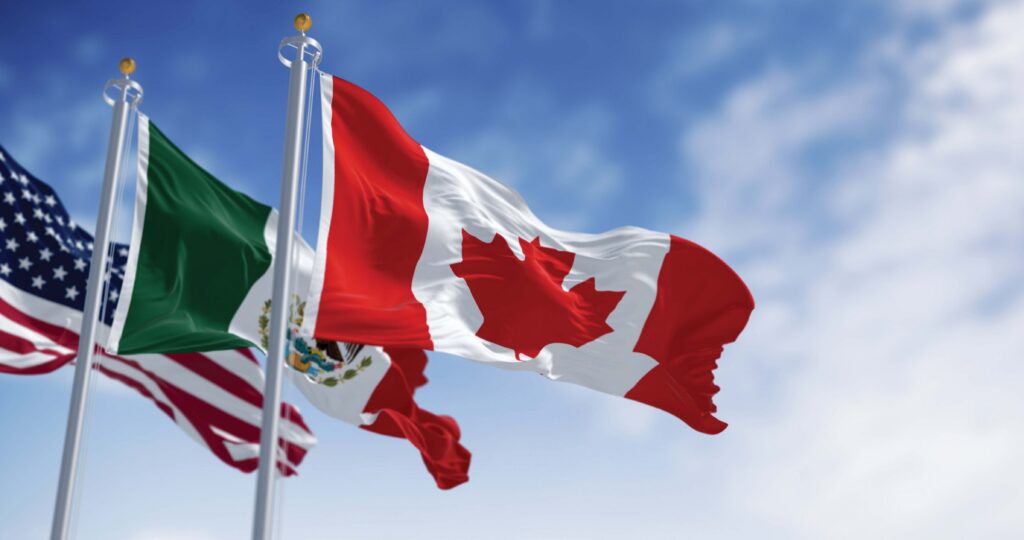
The United States-Mexico-Canada Agreement (USMCA) took effect July 1, 2020, replacing the North American Free Trade Agreement (NAFTA), which had been in effect since 1994. It governs how textile and apparel goods move duty-free between the U.S., Mexico and Canada.
The agreement introduced tougher rules about where goods must be made, gave customs officials new inspection powers and changed the amount of foreign material that companies can use and still qualify for duty-free treatment. These changes have affected how textile companies source materials, manufacture goods and import products across North America.
The first mandatory six-year review of the USMCA took place July 1, 2026, amid escalating enforcement activity. Textile companies should take a moment to ensure compliance and prepare for possible changes ahead.
Rules for textiles
The USMCA’s primary rule for textiles and apparel is the “yarn forward” rule, which originated under NAFTA. This means that for a product to qualify for duty-free treatment, the yarn must be spun and all subsequent production processes such as weaving, cutting and sewing must occur within the U.S., Mexico or Canada.
Cotton and synthetic fiber knit fabrics face an even stricter version called the “fiber forward” rule, which defines the origin requirement at the fiber stage rather than the yarn stage. The USMCA also added new requirements not found under NAFTA, including the requirement that sewing thread, pocketing fabric, narrow elastic bands and coated fabric come from the USMCA region.
However, there is opportunity for flexibility. A “single transformation” exception allows companies to use non-regional fabrics for certain products, as long as the cutting and assembling happen in the U.S., Mexico or Canada. The “short supply” provision allows limited use of materials that simply are not available in the region. Further, tariff preference levels (TPLs) allow companies to bring in a specified quantity of non-regional yarns, fabrics, apparel and made-up textile goods duty-free if they are produced, formed and finished in a USMCA country and meet other requirements.
TPLs from NAFTA were restructured and rebalanced under the USMCA. Changes included reducing TPLs for U.S. imports from Canada and Mexico and increasing TPLs for U.S. exports to Canada of apparel and other finished textile goods to provide new export opportunities for U.S. manufacturers.
The USMCA also follows the requirement that textile products used by the U.S. Department of Homeland Security related to national security be manufactured with 100% U.S. content, consistent with the Kissell Amendment. The amendment applies to purchases by the Coast Guard and the Transportation Security Administration. This requirement stems from the U.S.’s inclusion in the 2012 World Trade Organization Agreement on Government Procurement.
Enforcement mechanisms and penalty exposure
The USMCA gives customs authorities stronger tools to check where goods really come from. One example is the “jump visit”: U.S. Customs and Border Protection (CBP) can now schedule a factory inspection with only 20 days’ notice to the exporting country. If a factory repeatedly refuses these visits, it can lose its USMCA duty-free benefits.
U.S. CBP has ramped up its enforcement significantly. In early 2024, it sent a Textile Production Verification Team (TPVT) to Mexico to inspect 31 factories. Looking across fiscal year 2024, TPVT inspections covered factories in Mexico, Honduras and other partner countries responsible for roughly $800 million in preferential textile imports. The results were striking. More than one in three factories failed to meet the origin requirements, with the failure rate jumping from 21% to 38% in a single year. Separately, lab testing found that 42% of shipments had inaccurate origin information or content declarations.
Beyond TPVT inspections, CBP has several other ways to enforce these rules. If a factory fails a jump visit or TPVT inspection, CBP can deny the USMCA claim entirely and reassess the shipment at the full standard duty rate — which averages around 16% for textiles. In practice, this turns a duty-free shipment into a costly, retroactive bill.
CBP can fine importers and other companies in the supply chain if they misstate a product’s origin, fiber content or classification. The size of the fine depends on how the mistake happened: up to twice the duties owed (or 20% of the shipment’s value if no duties were actually lost) for negligence or careless mistakes, four times the duties (or 40% of the dutiable value) for gross negligence or seriously careless mistakes, and up to the full domestic value of the goods for intentional fraud. There is also a separate USMCA-specific penalty for submitting a false certificate of origin, giving CBP another tool beyond its general fraud and negligence penalties.
The first joint review
On July 1, 2026, the USMCA Free Trade Commission held its first mandatory six-year review as required under the USMCA agreement. The U.S. declined to renew the agreement for another 16 years in its current form, while Mexico and Canada each confirmed their support for a full 16-year renewal. Because the three countries did not agree, the USMCA will now be reviewed every year going forward until the parties either agree to extend the agreement or it expires on July 1, 2036.
Notably, the USMCA stays fully in effect no matter the outcome of the July 1, 2026, joint review. The parties can still agree to a 16-year extension at any point as negotiations continue.
Proactive recommendations
Taking some proactive steps can help your business prepare for the occasion when regulations do change.
• Audit your supply chain’s origin compliance. Take a close look at your supply chains to confirm that any goods claiming USMCA duty-free treatment actually meet the origin rules, including yarn-forward and the new component requirements. This goes beyond simply relying on supplier certifications — companies should endeavor to proactively verify the actual origin of yarns, fabrics and other components.
• Strengthen your documentation and recordkeeping. Make sure certificates of origin are complete, accurate and supported by records that trace materials through the entire production process. CBP requires importers to keep these records for at least five years. Because CBP can now show up for a jump visit with little notice, companies should be ready to prove compliance at the factory level at any time.
• Keep an eye on TPL utilization. If your company relies on TPLs, closely monitor how much you have used and plan in case you run out mid-year, especially given that the USMCA has reduced certain TPL amounts.
• Check for transshipment and circumvention risk. Evaluate whether your supply chain partners or sourcing arrangements could expose you to circumvention risk. Put controls in place, such as independent verification and regular factory audits, to catch potential issues early.
• Stay on top of ongoing negotiations. Now that the formal joint review period has ended and annual reviews are required going forward, companies should closely follow future negotiation rounds, noting that these negotiations are likely to shape near-term changes to origin rules, TPLs and enforcement.
• Double-check your product classifications. Review your Harmonized Tariff Schedule classifications for accuracy and consistency. Getting this wrong can mean losing duty-free treatment, facing penalties and drawing more audit scrutiny.
The USMCA offers real cost savings through duty-free access for qualifying textile and apparel goods. However, the yarn-forward rule, stronger inspection procedures and CBP’s growing enforcement signal to companies to have careful, ongoing oversight of their supply chains and documentation. With annual reviews now required and tariffs making compliance critical, textile companies should act now: Audit origin compliance, tighten up recordkeeping and get ready for potential regulatory changes ahead.
Audrey Karman is senior counsel at Womble Bond Dickinson (U.S.) LLP, based in the firm’s Washington, D.C., office. Her practice extends to guiding clients through investigations, remediation and post-resolution compliance obligations, including corporate monitorships. She is Chambers USA ranked for Foreign Corrupt Practices Act (USA-Nationwide).
SIDEBAR: Key takeaways
• The yarn-forward rule is still the gold standard. To qualify for duty-free treatment, yarn production and every subsequent manufacturing step must happen in the U.S., Mexico or Canada (USMCA).
• Sewing thread, pocketing fabric, narrow elastic bands and coated fabric also must come from the USMCA region. These are new requirements that go beyond what the North America Free Trade Agreement required.
• U.S. Customs and Border Protection enforcement is at an all-time high, with 38% of inspected factories failing origin checks and 42% of tested shipments having inaccurate origin or content information.
• July 1, 2026, the U.S. declined to approve a 16-year extension of the USMCA, which means the agreement will now be reviewed every year. The USMCA remains intact, and the three member states can still agree to a 16-year extension at any time.
• July 20, 2026, the Donald Trump administration announced new tariffs that went into effect Aug. 22, 2026, targeting Canada under Section 338 of the Tariff Act of 1930, including a 50% tariff on certain textile products — regardless of whether those goods would otherwise qualify for USMCA duty-free treatment. Companies should be aware that a valid USMCA certificate of origin will no longer automatically shield Canadian-origin goods from these new, higher tariffs.